
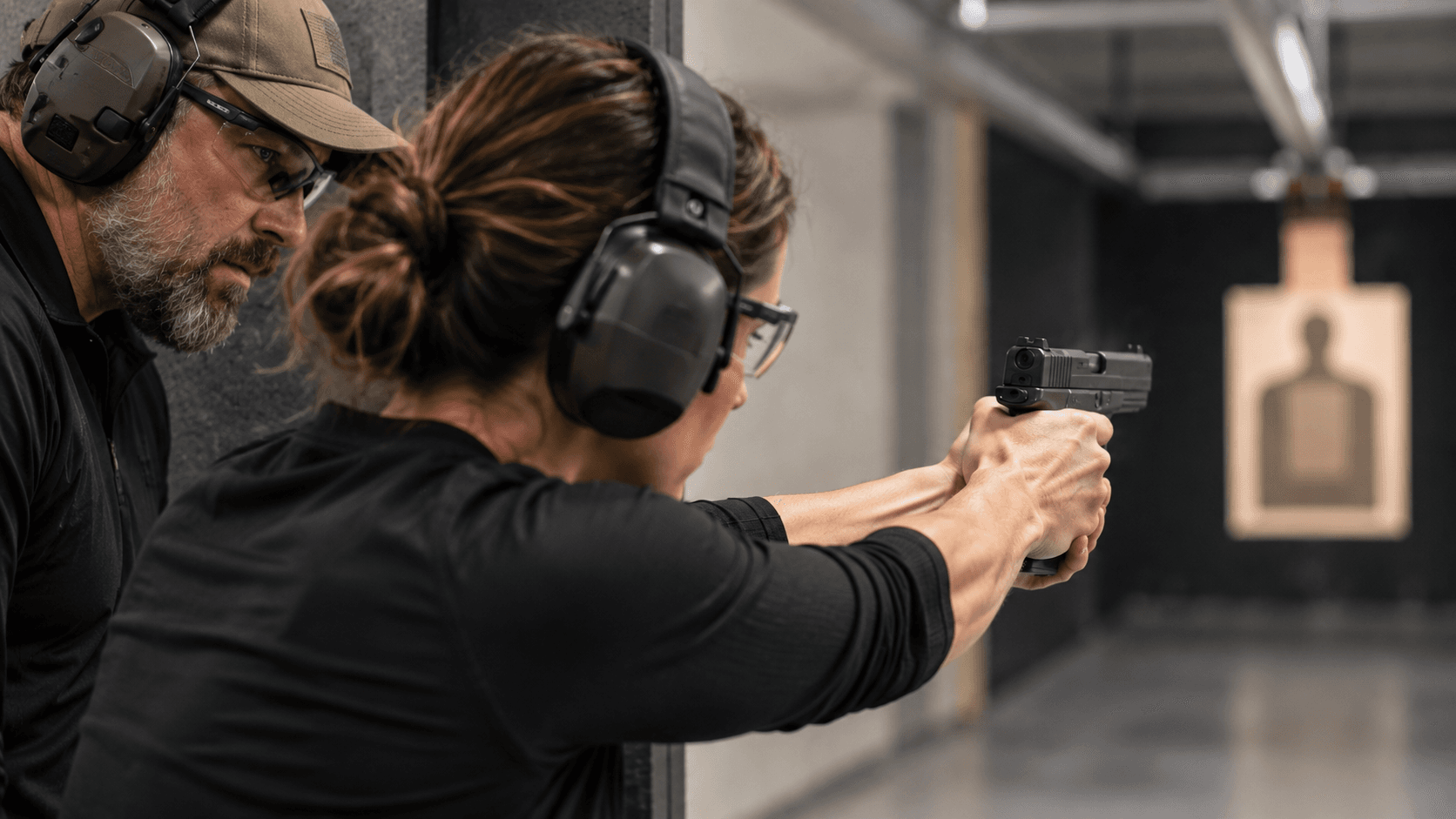
When a student's rounds start moving low and left under time pressure, the easy diagnosis is a bad trigger press. I look at the shooter's hands first. The target tells me where the rounds landed. It doesn't tell me why.
Many instructors start with the target. I start with the student, and use the target to confirm what I'm already seeing. Stance matters, but in my experience it's rarely the thing actually costing a shooter hits. Grip is, especially once a shooter starts stacking rounds on target in rapid succession.
The target tells me where the rounds landed. It doesn't tell me why.
A lot of what gets fixed in my classes has less to do with mechanics than with language. Instructors reach for shorthand: slow down, stop anticipating, quit jerking the trigger. Most of that shorthand describes the symptom without naming the cause. A correction isn't useful until I can name the specific action the student actually needs to change.
Pre-Ignition Push, Not Recoil Anticipation
Every shooter expects recoil. Expectation isn't the error. Movement is. I use the term pre-ignition push for movement that starts before the shot breaks and changes the pistol's orientation before the bullet clears the barrel. Calling that “anticipating recoil” does not identify the specific movement that needs to be corrected, since every shooter technically anticipates the gun firing. What I'm watching for is shooter-induced movement that changes the pistol's orientation before the shot breaks.
The same instinct applies to trigger slap and jerking. The amount of force on the trigger isn't the deciding factor on its own. The real question is whether the press moves the pistol before the shot breaks. Keep the sights aligned through the press, and the round generally goes where the sights were aligned when the shot fired. Disturb that alignment, however the shooter gets there, and that's the actual fault, not the speed of the finger.
“Slow down” gets the same treatment. It's one of the most overused phrases in firearms instruction, usually handed to a student with no explanation of what it means. Told to slow down without more, a student just takes longer to do the same thing wrong. I tell them something more specific instead: take the time you need to confirm the fundamentals required to make the shot. If a student needs an extra half second in the press to keep the sights aligned, that's the instruction, not a general command to slow everything down.
A student just takes longer to do the same thing wrong.
Diagnosing the Four Elements of Grip
The same instinct extends to grip. Instead of telling a student to fix their grip or grip it harder, I break grip into four elements I can observe and correct individually:
● Traction (friction): the actual contact between the hand and the grip surface, what keeps the pistol from shifting in the hand under recoil.
● Leverage: the mechanical advantage the hand has over the pistol, built through hand placement high on the backstrap and a firm, consistent wrist.
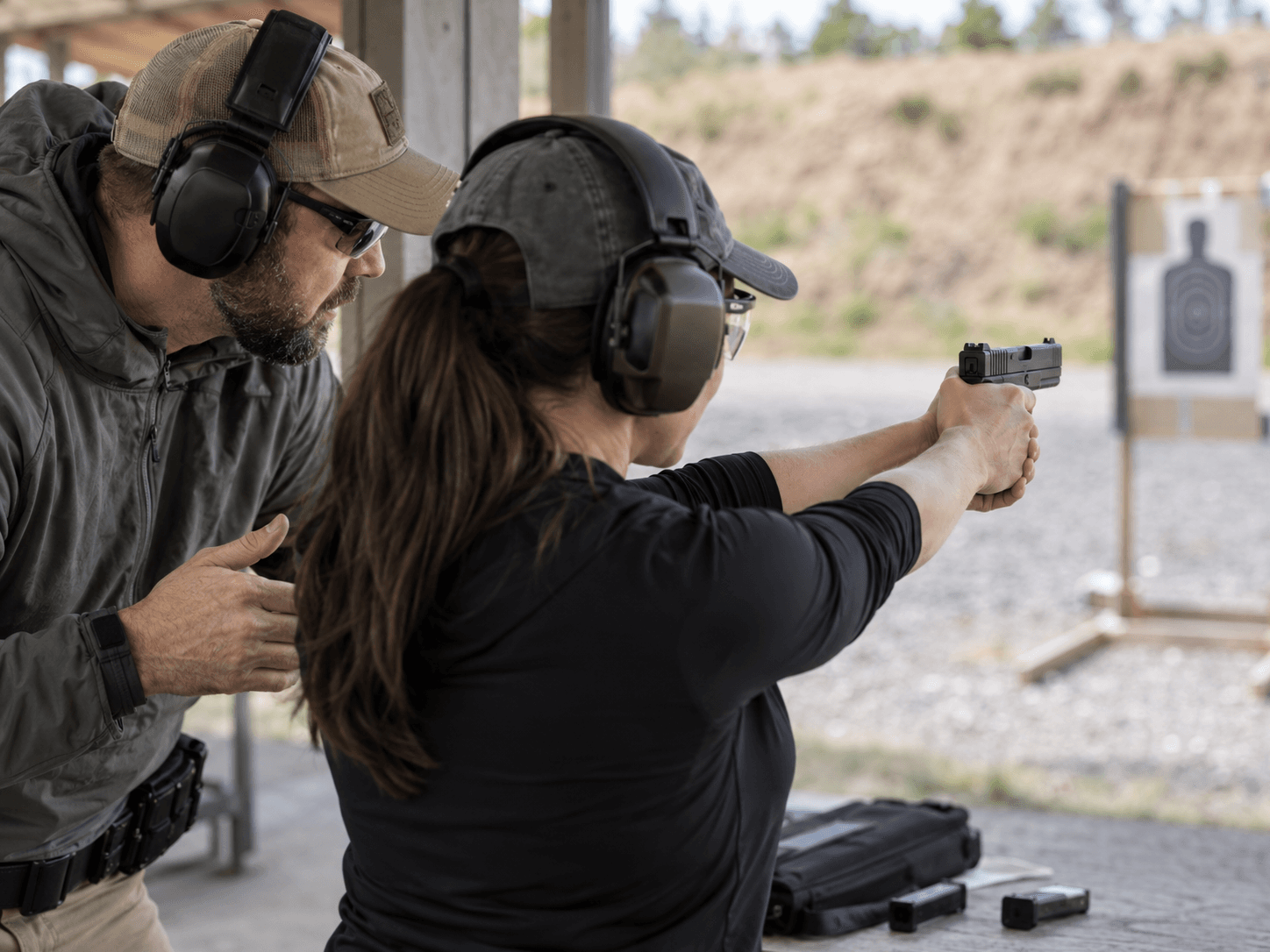
● Torque: the rotational force acting on the pistol as it fires, managed largely by the support hand resisting the gun's tendency to twist and rise.
● Fulcrum: in my framework, the web of the shooting hand functions as the primary pivot point the pistol rotates around during recoil, and it's the first place I check when a muzzle is climbing more than it should.
Those four fundamentals are what I credit with improving my ability to place accurate shots where they need to go under time pressure. Naming which element is missing, rather than telling a student to grip the pistol better, gives them something they can actually correct.
That is one possible explanation for the low-left pattern from the beginning of this piece. Read only as a target pattern, the standard response may be to blame the trigger press. When I see the support hand losing traction and torque, however, I know the shooter doesn't need a general instruction to slow down. The grip is the variable that needs to change. Their support hand wasn't controlling the pistol the way they thought it was.
The process behind all of this stays the same regardless of what I'm diagnosing:
1. Observe the shooter before interpreting the target.
2. Name the exact movement.
3. Identify when it occurs in the shot process.
4. Change one variable.
5. Retest under the same conditions.
None of it holds if the student isn't willing to apply the correction. I've watched plenty of students nod along to a fix and default straight back to the habit. The ones who improve stay open to hearing they're doing something wrong in the first place. I expect the same coachability from myself. Confidence can set in long before skill has actually been tested, especially after years inside one training system, so I put in fifty to one hundred hours of continuing education a year. We should never stop learning.
My advice to a newer instructor is to train deliberately under people outside your usual circle, including instructors who teach differently than you do. Try their method when it's safe to do so. You'll leave with something to incorporate or something you've tested and chosen to leave behind, and either result has value. What doesn't work is an explanation that stops at “because that's how we do it” or “that's how I was taught.” Neither answer tells the student what is happening or why the correction should work.
I spent most of my law enforcement career and firearms training in Illinois before I found the instruction that moved me forward. The department programs I experienced were largely organized around policy, qualification, and maintaining a minimum acceptable standard. The open training market introduced me to instructors who concentrated on diagnosis, experimentation, and performance beyond that standard. I wish I had known that instruction was available earlier. I did not find the better answer inside the system that trained me. I found it by leaving the room.
I did not find the better answer inside the system that trained me. I found it by leaving the room.