
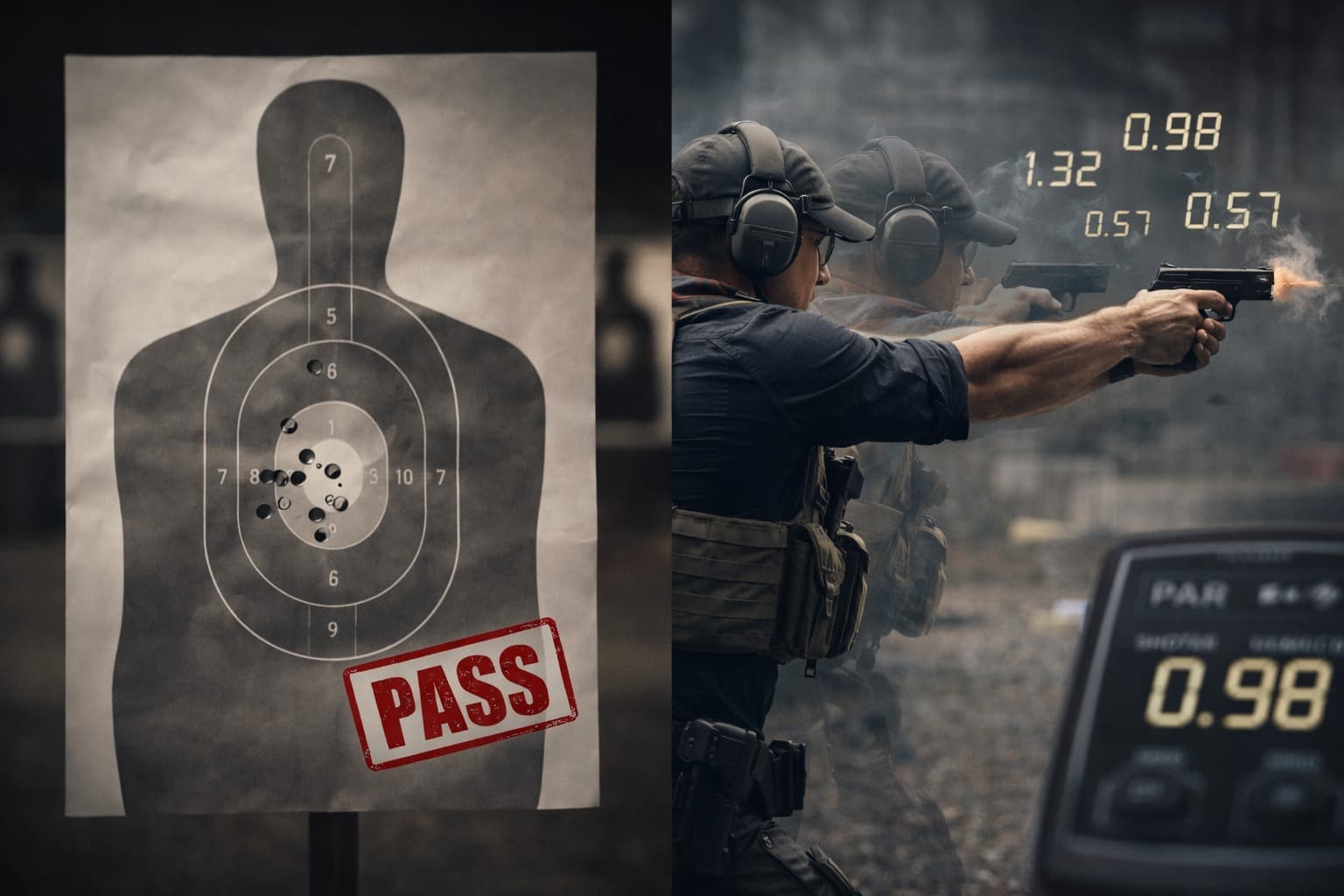
The qualification exists for a reason. It establishes a documented baseline. It creates a record that an officer met a defined standard on a defined date. In an era of increasing legal scrutiny over use of force, that record matters. Agencies built the qualification system carefully, and most have refined it over decades. I am not here to tear it down.
What I will say is that the qualification was never designed to answer the question that actually gets asked when something goes wrong.
That question is not: did this officer pass a firearms test? The question is: was this officer operationally ready on the day of the incident? Those are not the same question, and a qualification document cannot answer the second one.
I came to federal law enforcement as a science nerd and an EMT. No prior law enforcement background, no military, no range time to speak of. When I was hired by U.S. Border Patrol in 1997, I understood immediately that I was behind. The other recruits had experience I did not have. What I did have was a trained instinct for data, for measurement, for asking what something actually tells you versus what you assume it tells you. That habit of thinking never left me. And the longer I spent in the job, the more I applied it to training.
I spent 22 years with the U.S. Secret Service, the last several as a Regional Training Program Manager overseeing more than 200 agents across seven states. I also instructed at the Secret Service Academy. In all of that time, the qualification was the floor. Every serious trainer I worked with understood that. The problem is that for too many officers, in too many agencies, the floor became the ceiling.
Here is what the qualification measures: can this officer hit a target, at a standard distance, under controlled conditions, often enough to meet a pass threshold? That is a mechanical question. It has a binary answer. Pass or fail. It gets documented and filed.
Here is what it does not measure: how fast. How consistently. How that speed holds at longer distances. How performance changes under time pressure, fatigue, or the kind of stress that does not exist on a qualification range. Whether the officer who passed in January is performing at the same level in October.
A qualification score is a photograph. Operational readiness is a film.
An officer qualifies in March. By October, no one can say whether his draw time has increased by 40 percent, whether his split times have degraded, or whether his performance under time pressure has collapsed entirely. That information does not exist. The only record in the file says he passed. It says nothing about where he is now. And if something happens in October, that is the file everyone is looking at.
I have sat in rooms where that question was asked and the only answer available was a pass/fail record from several months prior. Not because anyone was negligent. Because the system was never built to capture anything else. The qualification answered what it was designed to answer. The problem is that the question being asked in that room was different, and nobody had the data to answer it.
That is a measurement problem. And measurement problems have a specific character: they are invisible until the moment they are not. Nobody feels the absence of data until the data is needed. By then it is too late to collect it.
What I watched the best agencies do, and what I tried to build into every program I ran, was treat qualification as the entry point rather than the destination. Once an officer could qualify reliably, we pushed them. Shorter time standards. Longer distances. Shoot and no-shoot decisions layered into the same evolution so the mechanical and the cognitive were being tested together. The goal was not a better score on the same test. The goal was a different category of data entirely.
The qualification records a date and a pass. A shot timer records a performance. When you introduce timed standards into training, shorter splits, longer distances, consistency tracked across sessions, you are no longer asking whether the officer hit the target. You are asking how sharp this officer actually is right now, and whether that sharpness is holding.
One is a credential. The other is evidence.
That distinction is not semantic. A credential says you were once measured and passed. Evidence says here is what the record shows across time. In any domain where performance degrades under stress and the consequences of degradation are severe, the difference between those two things is the difference between documentation and accountability.
The technology to capture this has existed for years. Shot timers have been standard range equipment for decades. What most agencies lack is the infrastructure to make that data verifiable and portable. A record that travels with the officer. That reflects current readiness rather than last cycle's pass. That holds up when the hard questions get asked in a review or a courtroom. The hardware is not the problem. The documentation layer is.
A science background teaches you something about this pattern. In any system where you are trying to understand performance over time, a single data point tells you almost nothing. Two points give you a direction. A series gives you a trend. The qualification gives agencies one point per cycle. What they need is a series. What they need is trend data that can be read, acted on, and if necessary, defended.
The agencies serious about officer preparedness are going to need more than a pass/fail record. They are going to need something that captures timed performance and tracks it over time. Something that produces documentation that holds up to scrutiny. Not instead of the qualification. Beyond it. That is not a high bar. It is just a different one.
The gap between what the qualification documents and what actually happened is where careers end and families grieve.