
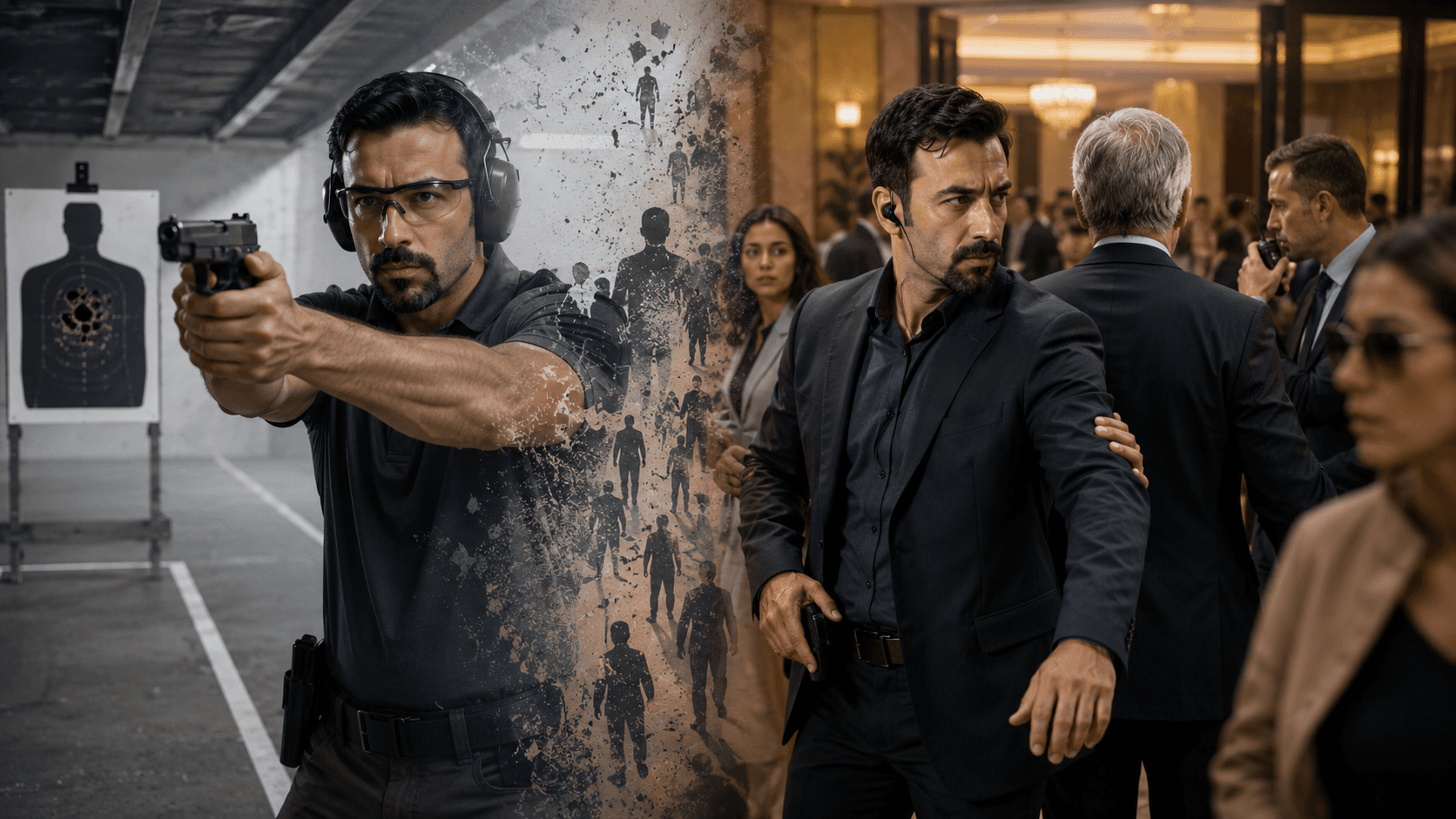
Put an operator on a static range and watch them shoot. Clean groups, consistent splits, controlled breathing. The numbers look right. Then put that same operator in a crowded hotel lobby with a principal six feet ahead, an unidentified contact closing from the left, and a radio call breaking up in their earpiece. The groups disappear. So does the breathing.
That is a design failure, not a training failure. The range measures marksmanship. Building programs around qualification scores produces operators ready for the test. Not the environment.
What the Job Actually Requires
Effective protection work is not a shooting problem. It is a decision problem that occasionally requires shooting. The operator's primary task is threat detection before escalation, not reaction after it. By the time a firearm is drawn in a real protection scenario, multiple earlier decision points have already failed.
I have watched operators who qualify at 95 percent on a flat range freeze during a vehicle ambush drill. Not hesitation. A full stop. The environment changed, the principal was moving, and two simulated threats appeared from separate angles. The marksmanship was there. The cognitive load broke them.
The operator who can shoot well on Tuesday will not necessarily protect anyone on Wednesday.
Close protection training must build threat discrimination and situational awareness under team movement. Marksmanship sits underneath that. It does not carry the job.
The Cognitive Gap Nobody Trains For
Most programs do not train the brain under load. They train the hands. The hands perform well when the brain is calm. Under real operational stress, the brain narrows. Tunnel vision sets in. Communication degrades. Reaction time that looked sharp on the flat range extends by seconds that matter. Operators start solving the problem directly in front of them and stop seeing everything else.
Stress inoculation fixes this, but only when it runs every session. Noise, physical fatigue, simultaneous radio traffic. Not as a test. As a baseline condition. After enough of it, operators stop processing threats from scratch. They recognize shapes. The OODA cycle shortens not because they think faster but because they have already been here.
Tactical breathing is not a wellness technique. It keeps the heart rate below the threshold where fine motor control and rational thought begin to degrade. Operators who do not practice it under stress do not use it when they need it.
The Soft Skill Problem Nobody Wants to Admit
Behavioral analysis and proactive threat detection prevent more incidents than firearms training does. I have been in rooms where operators could field-strip a weapon in under a minute and had no idea how to read a crowd. They were watching for someone to act. They were not watching for someone about to act. The range was quiet. The lobby was not.
Most incidents are preventable. They become unavoidable the moment no one was looking at behavior early enough.
Shoot and don't-shoot discrimination drills address part of this. Moving targets in a crowd, bystanders in the line of fire, time pressure. The operator has to identify the actual threat without creating secondary casualties. Running this drill 50 times builds a judgment pattern that flat-range shooting never touches.
De-escalation sits above all of it. The operator who can talk a contact down in a hotel corridor has kept the principal safe without exposure and without a report being filed. Most programs give it half a day. Then wonder why operators default to posture.
What Dynamic Training Actually Looks Like
Scenario-based training in 360-degree environments. Embussing and debussing drills under time pressure with a simulated principal. Simunition rounds in confined spaces with noise running. The operator does not know where the threat is coming from. That is the point.
After-Action Reviews following each scenario. Not to grade the shooting. To examine the decision sequence: where awareness degraded, where communication broke down, what the operator was prioritizing at the moment the scenario shifted. The debrief builds more retention than the drill itself.
Vehicle transitions and multi-threat environments are not advanced content. Treating them as advanced means the baseline was already wrong.
The Leadership Gap Inside the Team
Technical skill does not produce leadership. Operators with strong tactical ability and no command experience will default to individual action when the team needs coordinated movement. I develop this through progressive delegation: small operational ownership first, then full team command under pressure.
Role-reversal scenarios put the technical expert in the leader role and force them to communicate rather than execute. Most find it harder than the shooting. Clear radio communication under stress is a trained behavior. It does not emerge because someone is experienced. I have seen operators with ten years on detail go silent under command pressure because nobody had ever put them there before.
The best shooter on the team can be running solo while the principal is exposed. That is a leadership problem, not a marksmanship problem.
Programs that produce operators who qualify well and fall apart in dynamic environments are not failing their students. They are failing the people those operators are supposed to protect.
The range score goes in a file. Everything else goes somewhere the file does not reach.
Most programs know this. They schedule another qualification.