
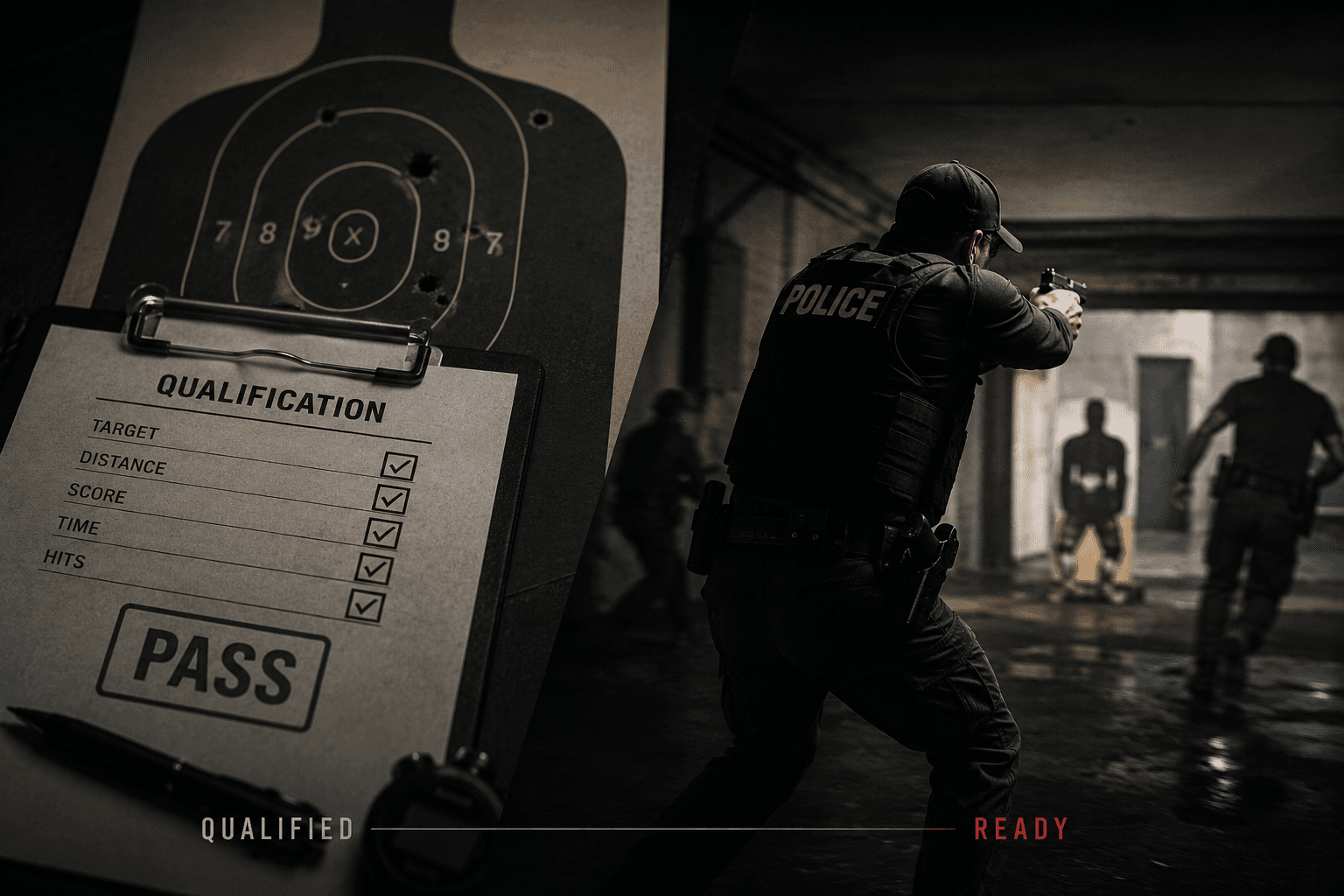
The profession cannot solve recruitment by lowering standards. Serious candidates are not drawn to lowered expectations. They are drawn to a profession that still knows what it is asking them to become.
Good officers enter this work to protect people and fight crime. When an agency trades standards for numbers, it does more than fill seats. It changes the culture those recruits are walking into.
Showcase a crime-fighting environment that is supported and encouraged, and I promise you will attract serious candidates. Lower the bar, and you risk filling those seats with the wrong people.
Everything else in training follows from that.
The moment that permanently changed how I think about firearms was not a complex tactical lesson. A simple, uncomfortable reminder: bullets travel through drywall. The round does not stop because the shooter is finished. Physics takes it into the next room, the next apartment, the next life. Every decision about target identification, backstop awareness, movement, and angles lives inside that fact. Marksmanship matters. The bullet does not care whether the shot looked clean on the range.
Most officers know this in theory. Fewer train with it in mind. The difference shows up in how they position, where they move, and whether they account for what is behind the target before they press the trigger. That gap between knowing and training is where people get hurt.
Serious training builds that awareness. Cultures that stop demanding it lose it quietly.
One of the most consistent gaps I see: we stop scenarios too early. Hostage rescue is the example. We train to get the hostage out of the room, then call the scenario. The mission does not end at the doorway. Extraction, scene security, medical care, communication, accountability. If training stops at the dramatic moment, officers learn to stop at the dramatic moment.
The debrief after that scenario should cover what happens next. Who secures the perimeter. Who calls it in. Who handles the casualty. When we skip those questions in training, we are not saving time. We are creating gaps that show up later when it counts.
Follow-through is a standard. When agencies cut it, they cut it quietly. Nobody files a report.
What looks like a marksmanship problem is usually an instructor problem. Some instructors are genuinely invested in the craft, in the responsibility, in the performance of the officer in front of them. Others are checking a box. The difference shows up in the student, sometimes right away, sometimes years later when pressure arrives and the foundation is not there.
My personal motto: train the basics at a high level.
Not about complexity. About refusing to treat foundational skills as low-level skills. My team harps on the basics constantly, but the standard is never just to perform them cleanly. The standard is to push them to their limit. Grip, draw, sight management, trigger control, movement, communication, reloads, target discrimination, follow-through. Not beginner topics. The skills that survive stress. When fatigue, fear, noise, and urgency arrive, officers fall back to what was trained deeply enough to hold. If the basics were never pushed, nothing is there to fall back to.
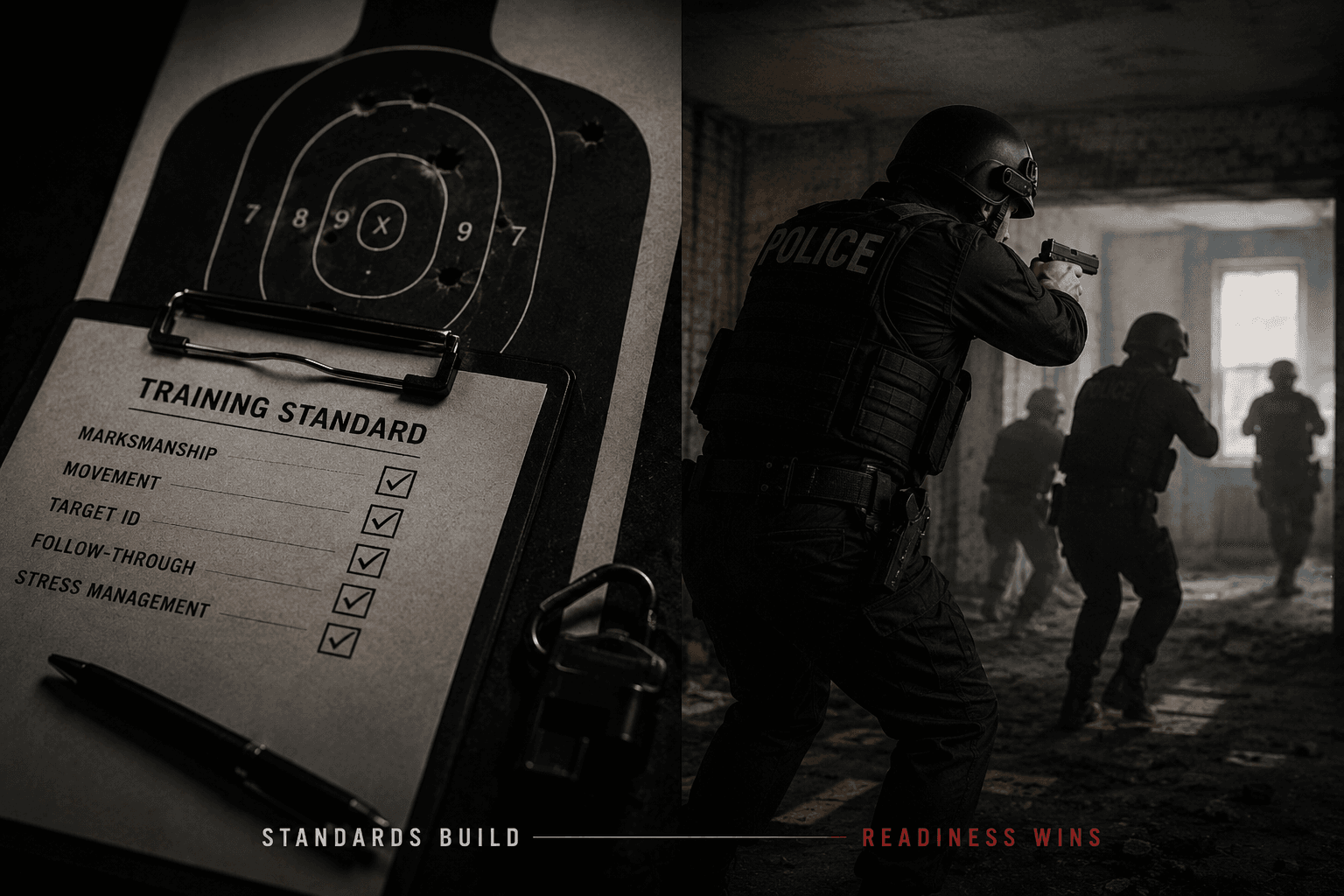
The instructor who treats the basics as entry-level content is producing officers who treat them the same way. That ceiling is built by the person running the range, not the person standing on it.
Firearms training for law enforcement gets it wrong when it leads with the qualification course instead of combat-style shooting drills. Qualification has a place. Standards require documentation.
A qualification course should be a checkpoint, not the curriculum.
It should confirm that training produced a capable officer. When it becomes the substitute for training itself, it confirms nothing except that the agency ran the course. Officers who only train to qualify will only perform to qualify. Under real pressure, that is not enough.
The real work is scenario-based. Stress exposure, decision-making under pressure, movement, communication, following the scenario all the way through. Not to the dramatic moment. Through it.
One more standard almost no agency measures seriously: stress management.
Law enforcement carries weight that does not disappear when the shift ends. The job gets into the body and the mind in ways that affect the next call, and the one after that. Stress management is not separate from firearms performance. It affects perception, patience, communication, trigger control, and the ability to know when not to shoot.
Officers who cannot find the release, who carry the accumulated weight of the job without an outlet, do not just burn out. They make worse decisions. Slower reads. Shorter fuses. The job will test every one of them eventually. The ones who found their release will respond differently than the ones who did not. Finding balance is not a wellness conversation. It is a performance requirement. Agencies that treat it as optional are building a readiness problem they will not see coming until it surfaces in the field.
For anyone carrying concealed: if you carry it, train it. Carrying without training is not preparedness. Possession. Preparedness requires repetition, judgment, discipline, and enough humility to know the firearm is one part of the responsibility. The decision to carry is also a decision to train. There is no version of that responsibility that does not include both. A gun in a holster without reps behind it is not a safety net. It is a responsibility the carrier has not fully accepted.
The profession does not have a training problem at its core. It has a standards problem.
Training only works when the standard is worth protecting.
Lower the standard at recruitment, and you set the ceiling for everything that follows. Hold it, support the people who came to do serious work, and training becomes what it was always supposed to be: preparation for the real thing.
The basics matter. The follow-through matters. The culture matters.
Stay trained. Stay ready.