
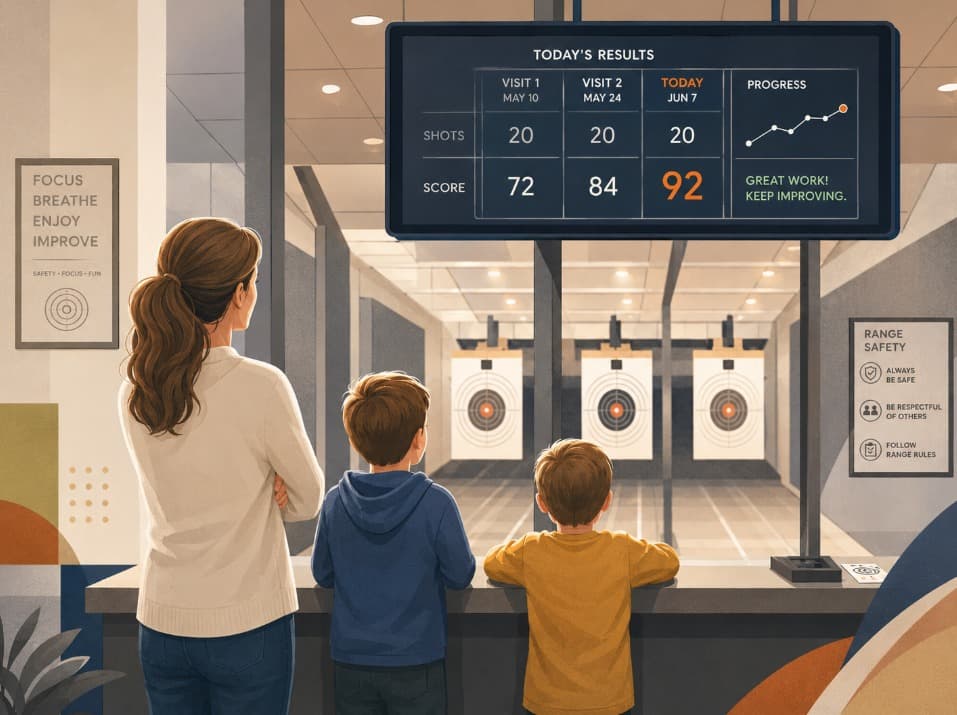
A few weeks ago, a mother brought her young sons to an indoor range. They weren’t there for a class. They weren’t training for anything. It was an afternoon activity, the kind of thing a family does together.
While her sons took turns on the lane, she watched, and asked a question that had nothing to do with tactics, defense, or competition: how do you know if they’re doing okay? Is this normal? Are they getting better?
There was no real answer available to her. No score she could compare to last time. No record of the visit beyond the shredded paper at the end of the lane. If she came back next month, there would be nothing connecting that visit to this one.
She wasn’t looking for a class. Her sons are too young for that, and she wasn’t trying to enroll anyone in anything. She just wanted to know what happened, and whether it meant anything.
That moment describes more about the firearms market than almost anything else.
Everyone is a target shooter
The industry tends to sort civilian shooters into categories: defensive shooters training around CCW and home protection, competitive shooters chasing classifications in USPSA or IDPA, and at the far end, Olympic shooters, for whom marksmanship is a coached, structured, lifelong discipline with no tactical framing at all.
But underneath all of these categories is one simple, literal fact. Every single one of them is shooting at a target.
The CCW student shoots at a target. The competitor shoots at a target. The Olympic athlete shoots at a target. So do the mother’s young sons, shooting paper at an indoor range on a Saturday afternoon.
Call this the broadest possible category: the Target Shooter. Not a tactical category. Not a competitive category. Not even necessarily a defensive one. Just someone, of any age, any skill level, any motivation, who shoots at a target and, in that moment, produces a result.
The industry has built systems around the other categories. Defensive shooters have CCW courses and renewal cycles. Competitive shooters have classifications, divisions, and rankings. Olympic shooters have coaches, federations, and decades of structured development.
What it has not built for is the act itself: shooting at a target and knowing what happened.
The missing layer is visibility
The underserved market is broader than any single persona. It includes the gear enthusiast, the weekend hobbyist, the parent bringing children to the range, the couple on a date night, the retired friends comparing targets, and the new owner who only shoots occasionally.
What they share is that their range experience usually disappears the moment the target is thrown away.
None of these people are necessarily missing a coach. None of them are necessarily looking for a pathway to mastery, not yet. What they are missing is much simpler: any sense of what just happened, whether it was good, and whether today was different from last time.
Every other repeated activity people do has some version of this. A fitness app shows a workout history. A golf scorecard shows a round. Even a casual mobile game shows a score, a streak, or a personal best.
Target shooting, for most people who do it, produces almost nothing permanent. The target gets thrown away. The visit doesn’t connect to any other visit. There’s no way to answer “are we getting better?” because there’s no record of “before.”
From a number to a path
Here is what happens once that changes.
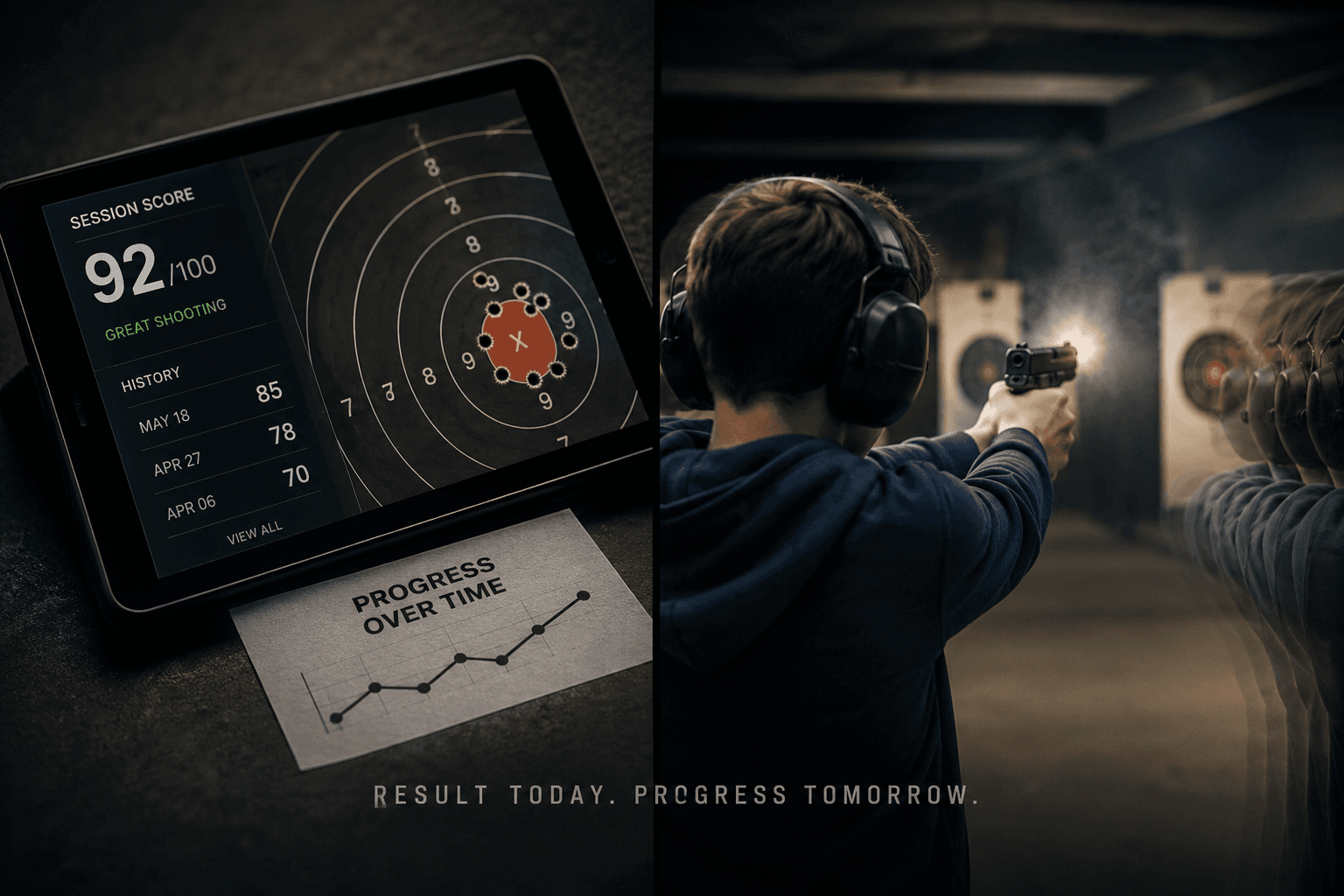
The mother sees her sons' scores from this visit. Next time, she sees them again, and now there's a comparison. Did the younger one's shots land closer together this time? Did the older one's score go up? A simple number has turned an afternoon activity into something with a direction.
That direction is the beginning of a pathway, even if nobody calls it that. A score that can go up invites the question of how high it can go. A level that can be reached invites the question of what the next level looks like. None of this requires anyone to enroll in anything. It happens because the number is now there to be curious about.
The retired contractor sees his score next to his buddy’s. Now there’s something to compare, and something to needle each other about. He didn’t ask for a competition. One showed up anyway, between two people who already liked each other’s company.
The mother’s sons, after a few visits, start asking what it would take to reach the next level. At some point, one of them mentions it to a friend, or wants to show a grandparent. A badge, a certificate, a small milestone, something that says this happened and this is where we are, starts to matter, not because anyone sold it to them, but because it’s the natural next thing once progress is visible.
From there, the path to formal instruction, or to a small, low-stakes local event where people compare results in person, isn’t a hard sell. It’s the obvious next step for someone who already has a number they care about and a curiosity about what’s next.
Why this matters to the instructor
None of this starts with a class, and that’s exactly why it matters.
Right now, the mother, the contractor, the date-night couple, and the occasional new owner are not in any instructor’s pipeline. They’re not searching for training. They may not even know they have a question worth asking.
The thread that connects one visit to the next doesn’t exist, so neither does the natural moment where an instructor can enter the picture.
Once that thread exists, the moment arrives on its own.
The mother sees her son’s score and wonders whether it’s normal for his age. That’s a question an instructor can answer in thirty seconds, if there’s a channel for her to ask it.
The contractor and his buddy start comparing scores and wonder what would actually help. That’s an opening for a recommendation, a drill, and eventually a session.
The sons reach for the next level and want to know what it takes to get there. That’s the first real reason any of them might consider a lesson, clinic, or class.
None of these people walked in looking for an instructor. The visible result brought the instructor to them, at the exact moment a question existed to ask.
That’s the opportunity: not a new class to sell up front, but a simple layer of visibility underneath an activity millions of people already do.
Visibility creates curiosity. Curiosity creates questions. Questions create trust. Trust creates the path to instruction, coaching, events, and long-term engagement.