
Every gunsmith, no matter how seasoned or well-equipped, eventually encounters a project that serves as a humbling reminder of the variables we manage daily. For me, that project arrived in the form of a pink XD40 Subcompact slide. It was a piece I had finished myself some time ago for my wife, and while she had enjoyed the vibrant change, the time had come to return the slide to something more traditional—a deep, classic blue-black finish. Having removed DuraCoat numerous times using standard chemical methods, I anticipated a straightforward afternoon of work. In this industry, however, expectations are often the first thing to be dismantled. What I assumed would be a quick twenty-minute turnaround evolved into an eight-hour education on the chemical resistance and mechanical tenacity of modern resin-based polymers.
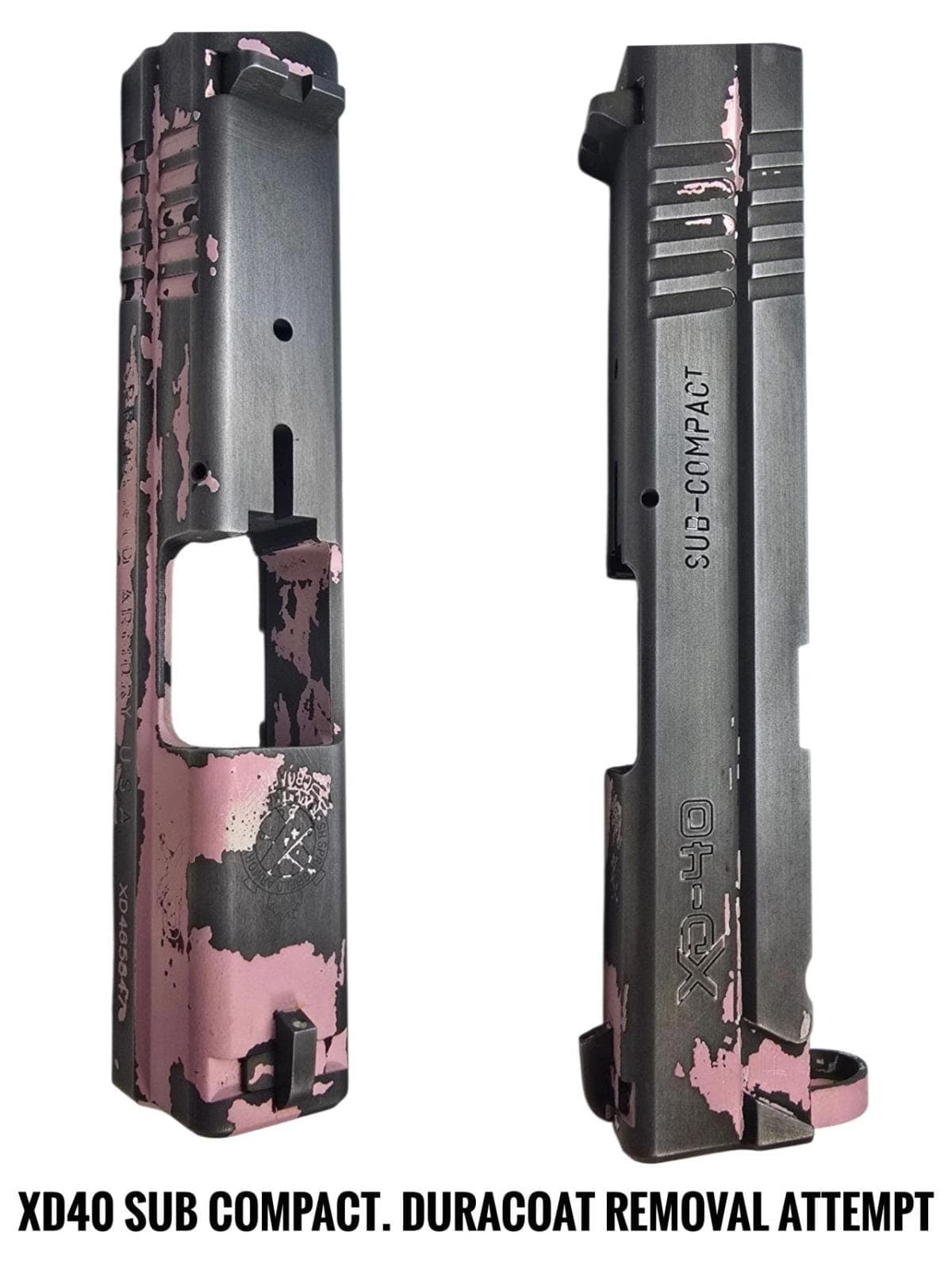
The process began with the standard operating procedure for any refinishing job: the ultrasonic cleaning tank. The goal was a simple thirty-minute cycle to degrease the slide and remove the everyday "funk" that accumulates on a carry gun. Under normal circumstances, this is a preparatory step, not a removal step. Yet, as I watched the clock, I decided to push the boundaries of the solution's capabilities. Based on some research and a desire to see if thermal energy could assist in breaking the bond of the coating, I cranked the tank temperature to 80°C. I let the slide run for a full hour, followed by another thirty minutes of intense vibration. When I finally pulled the steel from the solution, I expected to see at least the beginning of a failure—perhaps some softening or slight lifting at the edges. Instead, the pink coating was as defiant as the moment it went in; there wasn't a single bubble or hint of degradation.
This initial failure to produce a result was the first signal that I wasn't just dealing with a layer of paint, but with a finish that had achieved its authentic, "subconscious" bond with the substrate. In the world of firearm finishes, DuraCoat is known for its elastic, resin-based nature. When applied correctly—meaning the surface was properly abraded and degreased—the coating doesn't just sit on top of the metal; it integrates with the surface profile. This experience was a dramatic demonstration of what happens when that integration is successful. Seeing that the ultrasonic method was insufficient, I moved to a more aggressive chemical approach: aircraft-grade paint stripper. These compounds are specifically formulated to eat through tough polymer and epoxy-based coatings that resist standard solvents. Following the instructions to the letter, I applied a liberal coat and waited the requisite forty-five minutes.
The results of the aircraft stripper were a partial victory at best. It managed to peel away roughly 60 to 70 percent of the coating, but the remaining sections were stubbornly clinging to the steel in the recesses and across the flat surfaces. This is the point where a lesser product would have long since surrendered. The fact that the finish remained partially intact after a high-heat ultrasonic soak and a specialized chemical attack is a testament to the engineering behind modern protective coatings. At this stage, I was looking at a slide that was perhaps the most thoroughly degreased piece of steel in Georgia, yet it was still pink. It was time to return to the professional standard: the acid bath.
The difficulty of removal is the greatest endorsement of the original application.
I utilized a phosphoric and sulfuric acid-based stripper, the same type of compound used for metal preparation before coating. This is a strong acid that usually makes short work of epoxy finishes in ten to fifteen minutes. I fully disassembled the slide, ensuring no small parts would be compromised by the solution, and submerged it. Twenty minutes passed—the maximum safe contact time—and yet, the pink patches remained. A second fifteen-minute soak followed. When the slide emerged for the final time, rinsed and dried, those stubborn pink sections were still there, mocking the chemical potency of the acids. It had survived a gauntlet that would have stripped a dozen poorly applied finishes to the bare metal.
The final three hours of this eight-hour ordeal were spent with a pick and pure manual muscle. This is the "final reckoning" for any gunsmith—a task that requires extreme patience to avoid scratching or marking the substrate while forcing the remaining coating to release its grip. By the time the last of the pink was gone, I had spent a full workday on a task I originally quoted as a manageable afternoon project. For the professional, this creates a significant challenge in scheduling and customer communication. If we quote a flat rate based on "normal" removal times, a job like this can quickly become a net loss in terms of labor. However, the insight gained from this struggle is more valuable than the lost hours.
The Endorsement of Proper Application
This experience highlights a critical truth for both instructors and practitioners: the difficulty of removal is the greatest endorsement of the original application. When a coating comes off easily with acetone or a short acid soak, it is often a sign that the original surface preparation was flawed—perhaps the degreasing was incomplete or the surface profile wasn't aggressive enough to facilitate a proper bond. When the finish refuses to move, even under concentrated acid attack, you are seeing the result of a "subconscious," authentic bond where the coating has become a permanent part of the firearm's defensive layer.
Planning for Variables
For the gunsmith, the lesson is clear: plan for variables. We must have multiple removal methods available, from chemical strippers to mechanical blasting with 120-grit aluminum oxide at 80-90 PSI. Blasting remains the industry standard because it provides the controlled abrasion necessary to cut through these elastic resins without compromising the dimensional accuracy of the part—a critical factor for a subcompact slide where tolerances are tight. Glass bead blasting, while popular for its finish, often lacks the "bite" required to remove a truly bonded DuraCoat finish and can actually burnish the surface, making subsequent finishing more difficult.
The Transition to Traditional Bluing
Once the slide was finally clean, uniformly textured, and free of residual coating, the transition to traditional hot salt bluing could begin. This process is the antithesis of modern polymer coating. It is a chemical conversion that transforms the steel surface into a layer of black magnetite. Requiring precise temperature control, the parts cycle through a series of caustic salts, rinses, and oil baths. It is a demanding, traditional method that leaves no room for error; any residual contamination from the previous coating or the removal process would have resulted in an uneven finish or color variations.
The final result was a deep, even blue-black finish that met the customer's—and my wife's—expectations for a classic look. But the path to that finish was paved by the modern durability of the coating it replaced. As professionals, we must respect the engineering that goes into these finishes. When a manufacturer like DuraCoat states that their product is designed to resist chemical attack and mechanical abuse, it is not marketing hyperbole; it is a technical reality that we must account for in our shops.
Integrity in Practice
The takeaway for the industry is one of integrity. For the applicators, this is proof that your prep work matters. The difference between a finish that fails in a year and one that lasts a lifetime is found in the hidden steps—the degreasing, the profiling, and the curing. For the gunsmiths, do not underestimate the tenacity of a job done right. Budget your time, communicate the potential for complications to your clients, and always verify your variables before blaming your tools or your solutions.
We should celebrate the finishes that fight back, because they are the same finishes that protect the firearms our customers rely on in the field.
Ultimately, the fact that something is difficult to remove isn't a problem; it's evidence of quality. We should celebrate the finishes that fight back, because they are the same finishes that protect the firearms our customers rely on in the field. Whether it is a modern polymer that resists acid or a traditional bluing applied with meticulous care, quality finishing is an investment in longevity. In my shop, those eight hours weren't just a labor of love for my wife's XD40; they were a masterclass in the authentic durability of a professional bond.