
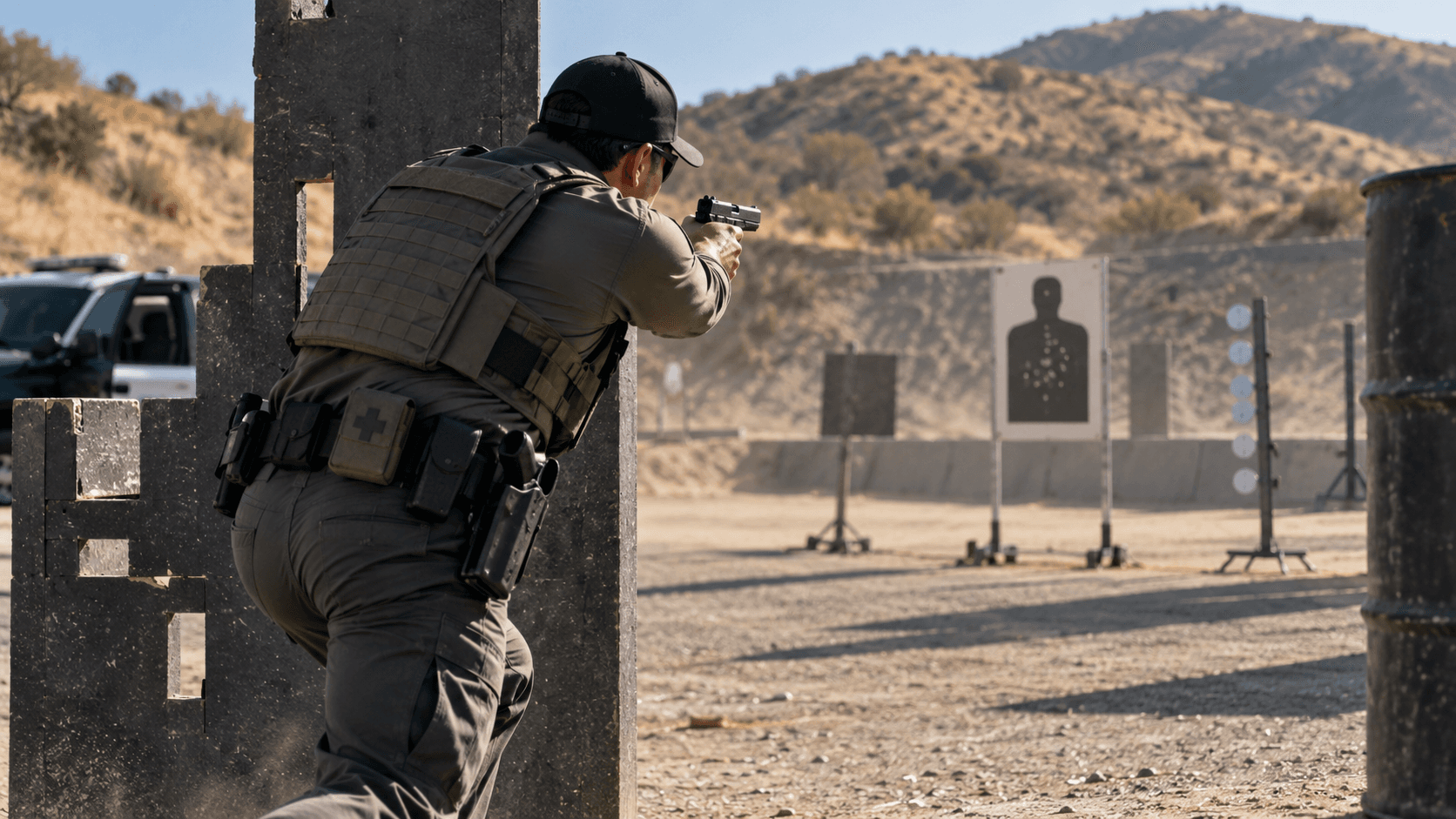
THE LOSS THAT CHANGED THE QUESTION
I lost a coworker in a violent encounter. That loss did more to shape how I think about firearms than any academy class or requalification ever did. It stripped away the idea that training is something you check off and move on from. It showed me how real the threat actually is, and how much distance sits between passing a qualification course and being ready for the thing that qualification is supposed to prepare you for.
Before that day I trained the way most officers train. Show up. Shoot the qualification. Go home. After that day I could not sit through a range session the same way again. The stakes stopped being an abstraction on a scorecard and became something I carried onto every call.
That is the moment everything else in this piece runs back to. Not a class. Not a mentor. A loss, and the question it left behind: would I have been ready either.
Most officers do not take shooting seriously. Qualification becomes a box to check instead of a skill worth building in between. Ask an officer what happens if a real threat shows up and you will hear some version of the same answer.
I will just unload and come out on top.
That confidence is not built on anything. Nothing tests it under real stress, against an unpredictable threat, with no warning that any of it was coming. It is a story an officer tells himself between qualifications, and it survives because standard training never forces it to be tested. Nobody fails a qualification for believing that story. Departments do not measure confidence against outcome, they measure it against a score sheet, and a score sheet cannot tell you who is actually ready.
I do not say this to blame individual officers. I say it because I used to be one of them, right up until the day I was not, and I know how comfortable that story feels to believe. Comfortable stories do not survive contact.
WHAT ACTUALLY BUILDS READINESS
Watch enough officers shoot and a pattern shows up fast. Inconsistent shot placement. Training scars built from years of repeating the same static drill. Bad information passed down from an instructor who learned it from someone else who never tested it either, and kept getting passed down because nobody stopped to ask where it originally came from.
A flat range and a static drill fix none of that. Departments lean on drills that do not resemble how encounters actually unfold, and they rarely train for the speed those encounters demand. An officer can group rounds tightly standing still and still not be ready the moment things start moving fast or the clock starts running. That gap does not show up on a qualification sheet. It shows up in the field, once, when it counts, and by then the sheet is worthless.
Call it a marksmanship problem if you want. It is not. It is a readiness problem wearing a scorecard, and departments keep grading the scorecard instead of the readiness. Fix the drill and you fix the number on the sheet. Fix the readiness and you fix what happens after the sheet gets filed away.
I stopped waiting on the department to fix this. I went looking for it myself. I sought instruction outside the agency, entered competitions, and put in practice on my own time, because nobody was going to schedule that growth for me.
That work changed something specific. My target acquisition speed and my transitions improved, and I kept acceptable shot placement while pushing both at the same time. Standing still and printing a tight group had nothing to do with what actually moved the needle for me. Competition forced a clock onto every rep. The clock does not care about your excuse.
The results carried past the range. Performance stayed consistent. Performance held under stress. Speed and accuracy stopped competing against each other and started working together, which is the entire point a qualification course misses by design, not by accident.
This is not one department's problem. It shows up anywhere training stays frozen in the old model. Departments run on an if it ain't broke, don't fix it attitude, and nothing forces that attitude to change until something breaks somebody, and then it is treated as an isolated tragedy instead of a predictable outcome.
Old-model training cannot close this gap by repeating itself louder.
An agency can run the same qualification course year after year and still produce officers who are not ready the first time a threat moves in a way the course never simulated. The gap is not a mystery. It is a choice departments keep making by default, requalification after requalification, and every officer who trains inside that default inherits the gap along with the badge.
There is no tone or beep before it happens. You are not sitting there ready. It happens while you are completely focused on something else: mid-conversation, mid-report, mid-anything, on a day that looked like every other day right up until it did not.
Seek out training beyond what your department requires. Add tools to what you already carry. Keep practicing after the qualification is over, not just before it is due, because the gap between those two dates is where the checkbox mentality lives.
There is no tone or beep before it happens. You are not sitting there ready.
The next encounter will not wait for you to decide you are ready. It will not check your schedule, your caseload, or whether you feel like today is the day. It just shows up, and what you did on every ordinary day before it decides what happens next.