
THE MISSION SHAPES EVERYTHING
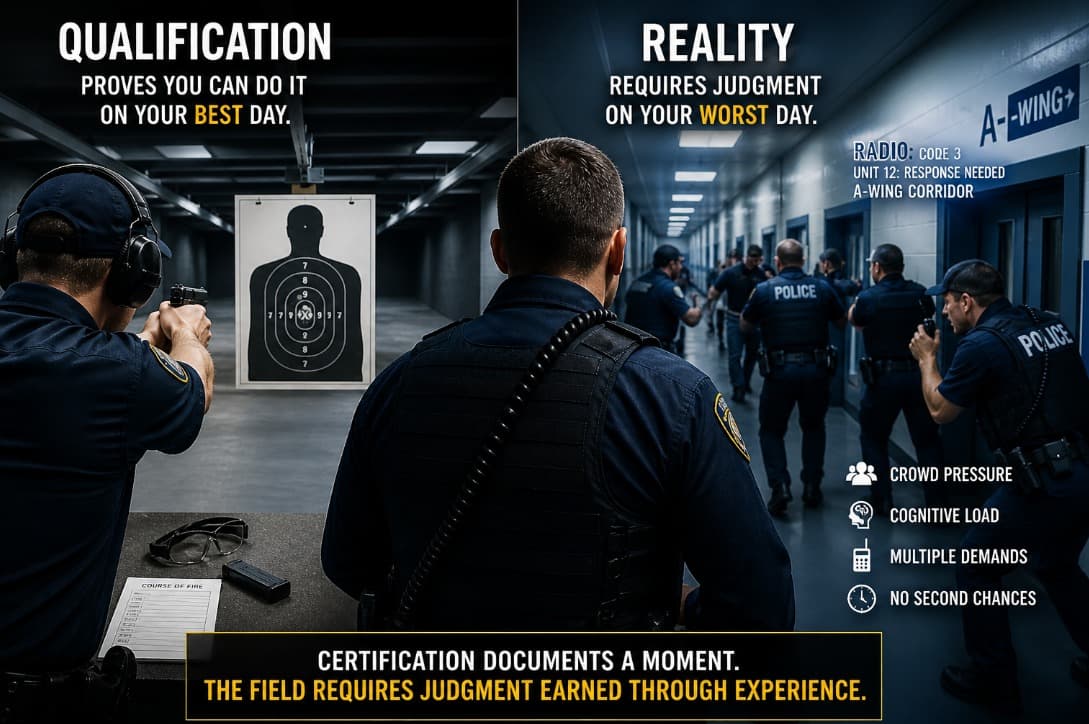
The firearm is not the mission. The mission is to keep a specific person safe, avoiding escalation wherever possible, and surviving the encounter if avoidance fails. The firearm exists within that sequence.
Law enforcement moves toward a threat. Military personnel often operate in environments where de-escalation is not the primary framework. A protection professional does the opposite manages risk, moves the principal, and engages only as a last resort.
The required firearms skill is not marksmanship in isolation. It is marksmanship integrated into movement, communication, and rapid decision making under uncertainty. Those skills must be trained together. Research and field experience both show that integrated training is what supports retention and real world application.
The same logic applies across security roles. A personal protection officer working within a team must rotate through and understand all roles, respond to threats while moving, and make decisions with a principal who is not cooperating with the scenario. A general security professional managing an escalating disturbance in a crowded environment must identify cover, move deliberately, and make decisions within legal and environmental constraints.
Neither of those situations looks like a flat range with a standardized course of fire.
What I have seen across sectors is training that is too static, too infrequent, and too disconnected from the actual role. Qualification is the floor. In many programs, it has become the ceiling.
A person who is accurate on a flat range but cannot execute under pressure is not prepared for the job.
A person who is accurate on a flat range and cannot execute that integration under pressure is not prepared for the job.
JUDGMENT DOES NOT DEVELOP ACCIDENTALLY
The skill that determines outcomes in protection and security work is judgment under pressure reading a situation that is not cooperating, identifying the actual problem, managing competing demands, and making a defensible decision with incomplete information and no pause button.
It does not develop on a static range.
It develops through repeated exposure to conditions that require it: force-on-force scenarios, shoot houses, and decision based drills. These should not be treated as advanced modules. They are the mechanism through which the gap between qualification and capability closes.
The officer who performs well in a controlled scenario and then freezes when the crowd shifts or the principal stops cooperating is not failing because they lack skill with a firearm. They are failing because their training never introduced that combination of pressure fatigue, split attention, and a timeline moving faster than protocol anticipated.
Those conditions must be trained. Not described. Not listed in a curriculum. Trained.
If they are not, the first time someone encounters them will be in a real incident and we become dependent on luck for success.
Documentation matters here as well for reasons beyond development. In private security, there is no qualified immunity. Consistent, well documented training under realistic conditions is part of legal defensibility. A record that shows attendance and a passing score documents presence not capability.
THREAT ASSESSMENT IS A COGNITIVE SKILL
Most training treats threat assessment as a checklist. It is not. It is a perishable cognitive and behavioral skill that develops through observation and interpretation, then the ability to explain it. Most programs skip that last part entirely.
The ability to explain why something does or does not present a risk is more valuable than the conclusion itself. It reflects the quality of the thinking, not just the output. A conclusion without reasoning is not assessment. It is a guess with confidence behind it. Training that skips the reasoning capacity does not develop the skill.
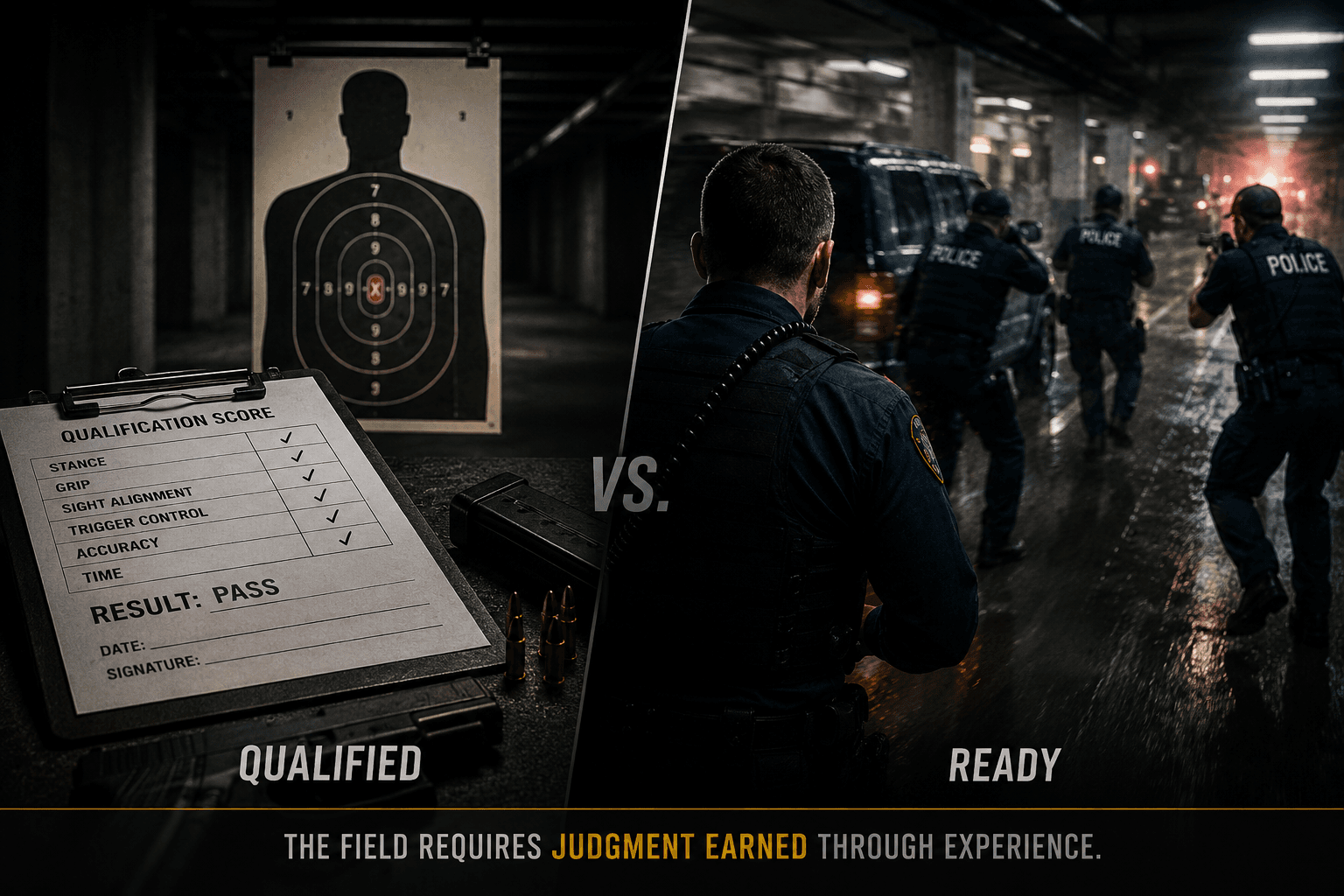
Better measurement looks at quality of observation over time. Are people identifying, and then acting on, pre-incident indicators before situations develop? Are reports forward-looking, describing what someone appeared to be preparing to do rather than just what happened? Are they documenting specific behaviors and rationale, or filing vague impressions that cover the minimum required? Those questions reveal whether a person is building actual assessment capability or learning to pass the evaluation. There is a difference. It shows up in the field.
Early recognition is the goal. The earlier risk is identified and managed, the less likely force is to be needed at all. Programs not oriented around that outcome are oriented around the wrong thing.
A conclusion without reasoning is not threat assessment. It is a guess with confidence behind it.
WHEN TACTICAL SKILL DOES NOT TRANSFER
One of the most consistent failures I have seen in protection and security organizations is the assumption that strong tactical performers will automatically be effective leaders. They won't. Not without deliberate development, and not without organizations being honest about what they are selecting for.
A person can be an exceptional shooter and a poor leader. In a protection operation, that gap shows up immediately. They manage their own task and lose the team. They make the right tactical decision and communicate it in a way that creates confusion at exactly the wrong moment. The skill that got them recognized is not the skill their new role requires.
Developing leadership in tactically skilled people requires putting them in positions where they must think beyond their own task. Rotate them through leadership roles. Hold them accountable for team outcomes, not just their individual performance.
Critique how decisions were communicated and executed, not just whether the shot was good on paper. After-action reviews with honest critique are not optional. They are where the reflection required for leadership development happens.
Organizations must be honest about what they reward. If shooting ability gets recognized, that is what people optimize for. Every time. If judgment and team effectiveness are what get recognized, those qualities develop. Most organizations in this space are rewarding the wrong things, and the leadership pipeline reflects it.
WHERE THE FRAMEWORK HAS LIMITS
My background in counterterrorism and intelligence analysis shapes how I think about force. The clearest lesson from that work is that force alone produces temporary success but does not solve the problem. The most effective units were defined by consistency and restraint as much as they were their ability to use force decisively. They reduced violence more effectively over time than units that relied primarily on overwhelming force. The difference was not capability or available resources. It was the judgment to know when and how to use each capability and resource and the willingness to follow through consistently.
A force-forward approach in civilian environments damages trust, escalates situations that didn't need to escalate, and increases liability. The goal is to operate as a consistent, accountable presence focused on the safety of everyone in the environment. The foundation of security is built through how you operate every day before a threat develops.
Security, done well, expands outward. It creates stability beyond the immediate task and stabilizes the surrounding environment.
What this means for training: it cannot stop at engagement. It has to address when not to engage, how to disengage, how to identify problems and select solutions, and how to manage situations. Building relationships within the environment you operate in is not a soft skill. It is threat mitigation. Programs that skip this are preparing people for the last resort while skipping everything that comes before it.
WHAT IS WORKING AGAINST IT
There is a pattern developing in private security that concerns me enough to name directly. A growing tendency toward rigid, absolute positions. Fixed thinking about role and tactics, shaped less by evidence and more by identity. You see it in phrases like "real professionals do this" or "real operators don't do that." Most of the time those statements are not about something being done incorrectly. They are about something being done differently. Gatekeeping driven by ego does not improve the profession. It limits it.
There is also a cultural resistance to acknowledging that the protector can become a source of risk. I have seen it in corrections and in protection work. Not in dramatic failures, but in the pattern of decisions made by people who were operating from a fixed sense of what their role required rather than reading what the situation needed. The escalation that did not need to happen. The force that was technically justified and tactically wrong. The industry has a cultural resistance to naming that pattern honestly, because it requires accepting that the person who was experienced, credentialed, and trained is responsible for making the situation worse.
As polarity increases in the broader culture it is showing up in private security in ways that affect operational judgment directly. When decision-making shifts from the situation in front of you toward maintaining alignment with a fixed identity, the ability to read situations and adapt degrades. That is the capacity that keeps people safe in high-pressure environments. When it degrades, it does not show up on a qualification record. It shows up in the reports that go somewhere other than the training program.
Closing the gap requires more than better training design. It requires programs and organizations willing to measure the things that predict performance, reward the capabilities that determine successful outcomes long term, and actively seek information from the environments that receive what they produce.
We don’t have a training problem because we lack knowledge. We have a training problem because we don’t consistently measure or reward what actually matters regarding performance.