
There is a pattern that becomes clear after enough time working with students and reviewing real world incidents, and it has very little to do with raw shooting ability. Most people who train with intent will improve their mechanics. They will shoot tighter groups, present more consistently, and develop a level of confidence that feels like readiness. The pattern shows up somewhere else usually before the gun is drawn, and almost always after the shooting is over. That is where the failures tend to occur, and those failures are rarely mechanical.
A useful way to frame the problem is through how skills are built. Most firearms training takes place in what would be defined as a closed-skill environment. The variables are controlled, the sequence is predictable, and the outcome is largely dependent on repetition and refinement. That is appropriate for developing fundamentals, but it creates a structural limitation. Real-world encounters are open-skill problems. They are reactive, ambiguous, and shaped by factors that cannot be scripted in advance. When someone trained primarily in a closed system is placed into an open one, performance does not degrade randomly. It degrades in very specific, observable ways.
HOW FAILURE ACTUALLY LOOKS
In scenario-based work, we track three failure patterns that appear consistently once legal ambiguity is introduced into a situation.The first is decision latency: a hesitation window of three to five seconds that opens when the student cannot quickly determine whether force is justified. They have been trained to shoot accurately, but not to evaluate. The gun is available; the authorization to use it is unclear. They freeze at the branch point.
The second pattern is premature escalation. This is the opposite failure, and in some ways more dangerous. The student, uncomfortable with ambiguity, resolves it by acting. An aggressive approach, a raised voice, a fast move toward a pocket any of these can trigger a draw before the situation has crossed the legal threshold. The mechanics are often clean. The timing is not. What follows is not a defensive shooting. It is an offense.
The third pattern is loss of verbal control. When stress rises, verbal engagement collapses first. Students who can articulate commands clearly on a flat range default to silence or incoherence under scenario pressure. This matters because verbal engagement is not just de-escalation it is documentation. What you say, when you say it, and how the subject responds is part of the record that investigators will reconstruct afterward.
The gun is available; the authorization to use it is unclear. They freeze at the branch point. That is a training gap, not a character flaw and it is entirely correctable.
ONE SCENARIO, WALKED THROUGH
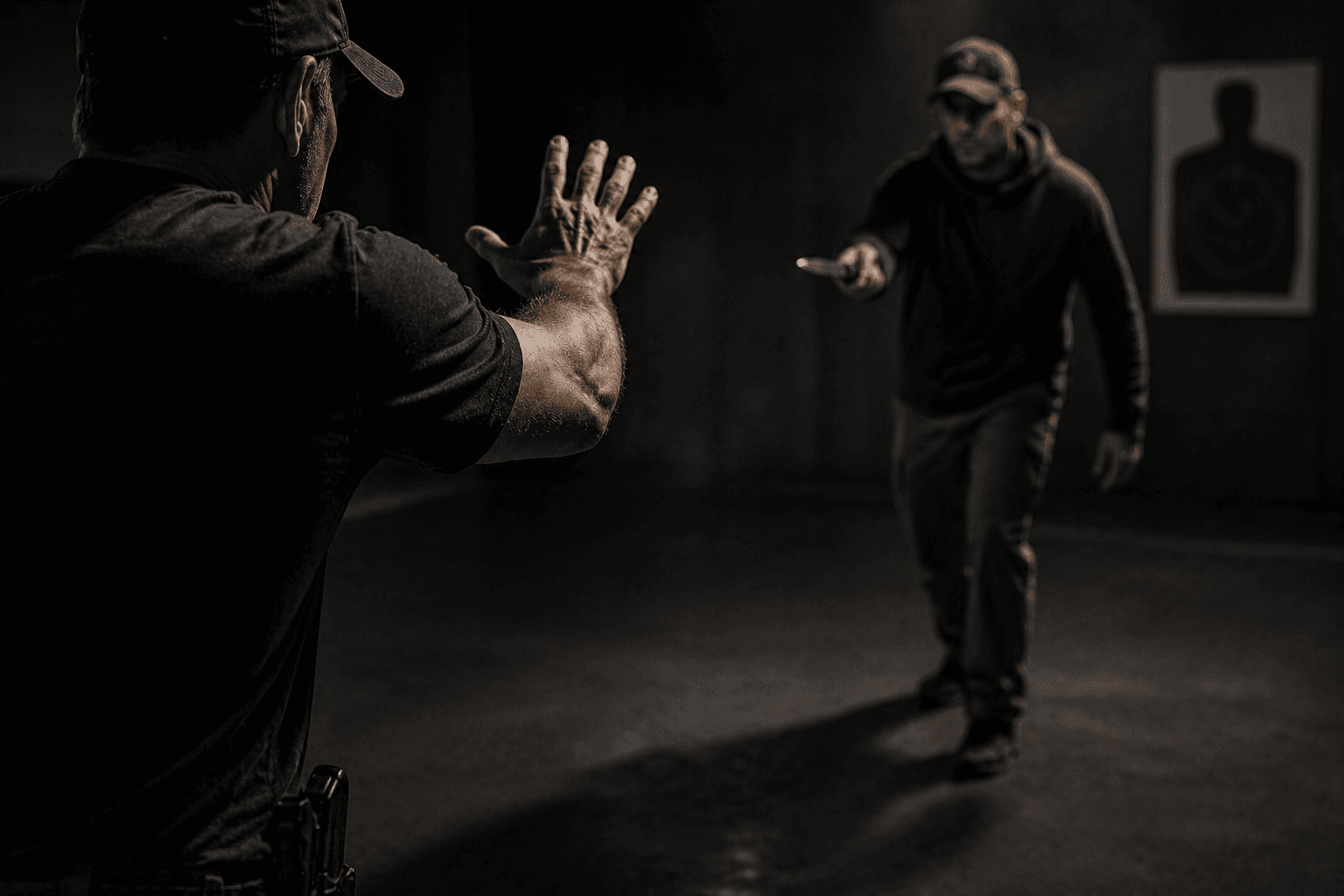
The following is drawn from a scenario block used in force on force training. It illustrates how quickly a defensible situation becomes an indefensible one, and how a single intervention point changes the outcome.
The Setup
0:00 Subject enters the space and begins moving toward the student at a fast walk. No visible weapon. Aggressive posture. Verbal content is hostile but nonspecific.
0:04 Subject closes to twelve feet. Still no visible weapon. Student has not moved or spoken.
0:06 Subject reaches eight feet. Student draws.
What Went Wrong
At eight feet with no visible weapon and no verbal engagement attempted, the draw is legally premature under Graham v. Connor's objective reasonableness standard. The student perceived a threat correctly. But the student skipped every intervening option. No lateral movement to control distance and angle. No verbal command to create space and establish record. No attempt to identify what was actually in the subject's hand or pocket. The immediate move to the firearm compresses all available decision space into a single binary: shoot or don't. That is not control. That is reaction.
The Correct Sequence
0:00 Subject enters and begins approach. Student begins lateral movement immediately not retreat, repositioning. This controls the angle and communicates awareness.
0:03 At fifteen feet, student issues a clear verbal command: stop, identify purpose, hands visible. Voice is controlled. Command is specific.
0:05 Subject does not comply and continues closing. Student has now created verbal record, established non-compliance, and maintained reactionary gap. Draw is now legally defensible.
0:07 If subject produces a weapon or makes a threatening motion, force is authorized and documented. If subject stops, the situation is managed without escalation.
The difference between these two sequences is not marksmanship. It is approximately four seconds and two decisions. Both are trainable. Neither appears on a standard qualification course.
ACTIVE POSITIONING AS TRAINABLE DOCTRINE
There is a meaningful difference between passive awareness and active positioning, and most training programs treat only the first. Passive awareness is scanning processing environmental data without acting on it. Active positioning is the deliberate management of your physical and spatial relationship to the environment before a threat has fully materialized.
Active positioning is not a reaction to threat. It is threat prevention through environmental control and it is one of the most undertrained skills in civilian and law enforcement contexts alike.
In practice, active positioning involves four measurable behaviors. First, angle management: always know where your back is and where exits are, and position yourself so that approaches require the subject to move through open space rather than behind you. Second, reactionary gap maintenance: keep a minimum of eight to ten feet of space between yourself and unknown contacts in confined environments. This is not a social norm; it is a decision buffer. Third, light and shadow awareness: in low-light environments, position yourself so that you are seeing into light rather than out of it. This asymmetry is significant. Fourth, deliberate eye contact at transition points: when someone's behavior shifts from passive to directed, make eye contact early. Not confrontationally deliberately. Predatory selection depends on perceived inattention. Remove it.
Each of these behaviors can be trained as discrete drills. Angle management drills run in building environments with instructors tracking positioning decisions. Reactionary gap drills use approach scenarios with a hard stop at the threshold distance. Light positioning drills run at dusk or in reduced light facilities. Eye contact drills are built into scenario work as a required behavior before any escalation is permitted. When these four behaviors are present together, a significant percentage of pre-contact confrontations disengage entirely. That outcome is not luck. It is architecture.
PHASE THREE: THE BATTLEFIELD AFTER THE SHOOTING
Most training addresses Phase One the pre-incident environment and Phase Two the use-of-force decision with at least some attention. Phase Three receives almost none, despite the fact that it is where many tactically correct responses produce legally catastrophic outcomes.
A defensive shooting does not end when the threat stops. It transitions immediately into a reconstruction process that will involve law enforcement response, witness statements, physical evidence collection, and in many cases, prosecutorial review. Every action taken in the first minutes after the shooting contributes to or degrades the legal record. Understanding that process in advance is not paranoia. It is part of the skill set.
The reporting phase begins the moment the threat is neutralized. What you say to responding officers matters not because you should be calculating, but because stress induced memory compression will cause you to omit critical details if you have not rehearsed how to articulate them. Training should include verbal articulation drills in which students must immediately state, post scenario: what specific behavior indicated threat, what alternatives were available and why they were insufficient, and why force was the necessary response. If a student cannot answer those three questions within ninety seconds of a scenario ending, the training gap is not mechanical.
Even a tactically sound response can produce long-term legal exposure when the person who made the right call cannot explain why they made it.
Articulation failures cascade. An officer or civilian who cannot clearly reconstruct the threat sequence creates investigative ambiguity. Investigators fill ambiguity with assumptions, and assumptions in use of force investigations tend to run against the shooter. Small gaps a missed verbal command that was actually given, a positioning decision that was intentional but unexplained become narrative liabilities. The solution is not legal coaching. It is rehearsal. Articulation under stress is a trainable skill, and it should be evaluated in every scenario block alongside the mechanical response.
The physical actions taken post incident also matter. Weapon retention, movement after the threat is down, how contact is made with responding units all of this is subject to review. Scenario training that ends at the last shot is incomplete. Phase Three should be a required component of every force-on-force exercise, with debrief that addresses legal exposure as directly as it addresses tactical performance.
THE COMPLETE STANDARD
All of this points toward a conclusion that is often counterintuitive for students who have invested heavily in marksmanship. Shooting is not the center of the system. It is one component within a broader framework that includes perception, decision-making, legal understanding, and post-incident behavior. Overemphasis on shooting creates what is effectively a competence trap—the individual defaults to a mechanical solution because that is where their training is strongest, even when the problem requires something else.
A complete standard for training evaluates performance across all three phases: what happens before the incident, how decisions are made during it, and how actions are justified afterward. These phases are interconnected. Failure in any one of them can compromise the entire outcome. Strength in one area does not compensate for weakness in another.
The range serves an important role, but it has to be understood for what it is. It is a laboratory for building components, not a map of how events will unfold. The students who carry those components furthest are not the ones who shoot the tightest groups. They are the ones who can articulate why they fired, account for every decision that preceded the shot, and walk out of a post-incident review with their judgment intact.
That is the standard. Train to meet it.