
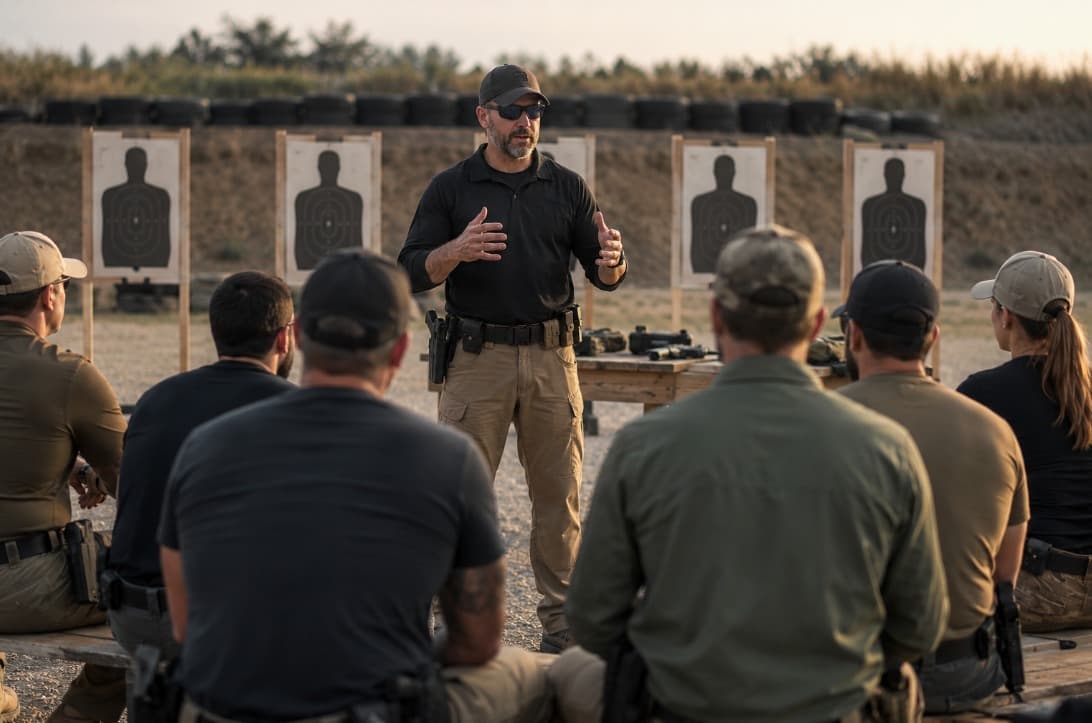
There's a view that resurfaces in this industry from time to time: that only people with combat experience are qualified to teach the defensive use of firearms. It's stated as if it was obvious, and beyond debate.
It isn't. It's gatekeeping dressed up as standards.
It denigrates the many thousands of civilian instructors who've put in the work to develop genuine craft. Worse, repeated loudly enough, it steers new shooters away from qualified instruction and toward credentials that have nothing to do with their ability to teach.
Let's be direct: combat experience is not a prerequisite for firearms instruction. It never was.
The question was never whether someone has been in combat. The question is whether their students can perform.
The Argument Against Civilians Doesn't Hold
The logic fails at its premise. There are innumerable combat veterans who should not be in front of a class. There are countless civilians who have the skills, knowledge, and teaching ability to develop excellent shooters. Suggesting otherwise conflates experience with transferability, and those are not the same thing.
Combat experience creates pattern recognition and situational calibration that is hard to replicate in a classroom. That is a genuine advantage, and it should be acknowledged. But it does not automatically produce instructors. In many cases, it produces experts who know exactly what works for them but struggle to transfer it to others.
Teaching is its own skill set. It requires the ability to build progressive curricula, explain and contextualize techniques, observe students, diagnose what's going wrong in real time, and modulate communication style. Combat experience does not train for any of that. Training to instruct does.
The Infrastructure Exists
Multiple organizations have built serious instructor-certification tracks. NRA certifies instructors across pistol, rifle, and shotgun disciplines. USCCA trains instructors for concealed carry, home defense, and defensive pistol. Sig Sauer Academy offers instructor certifications in over a dozen specialized areas, including low-light, mounted optics, and active shooter response. Tactical Hyve runs a dedicated Certified Pistol Instructor program.
Importantly, many of these “train the trainer” programs are led by veterans; veterans who readily share their experiences with civilians, and for whom civilian instructors should be thankful.
These programs build a real foundation, with a structured curriculum, range hours, and adult learning methodology. But they are a starting point, not a verdict. Certification proves you met a threshold at a given moment. It does not, on its own, prove that your students perform. That distinction matters, and the industry has been slow to make it.
What It Actually Takes
A LinkedIn post by a military-background instructor recently asked: 'How can you teach without real experience?' The answer is straightforward: through training, immersion, and talent.
Training means range time, both student-level and instructor-level. Force-on-target and force-on-force. Indoors, outdoors, shoot houses, varied weather, varied conditions. It means classroom sessions, webinars, and reading. The classics: Branca on laws of self-defense, Grossman on combat psychology, de Becker on intuition and conflict avoidance, Van Horn and Riley on threat detection, Ayoob on the full system. It means studying other instructors, including those with backgrounds you don't have.
Talent means the capacity to observe, communicate, adapt, and remain calm when things go sideways. It's either developed or it isn't, regardless of whether or where someone has been deployed.
What Makes a Good Instructor
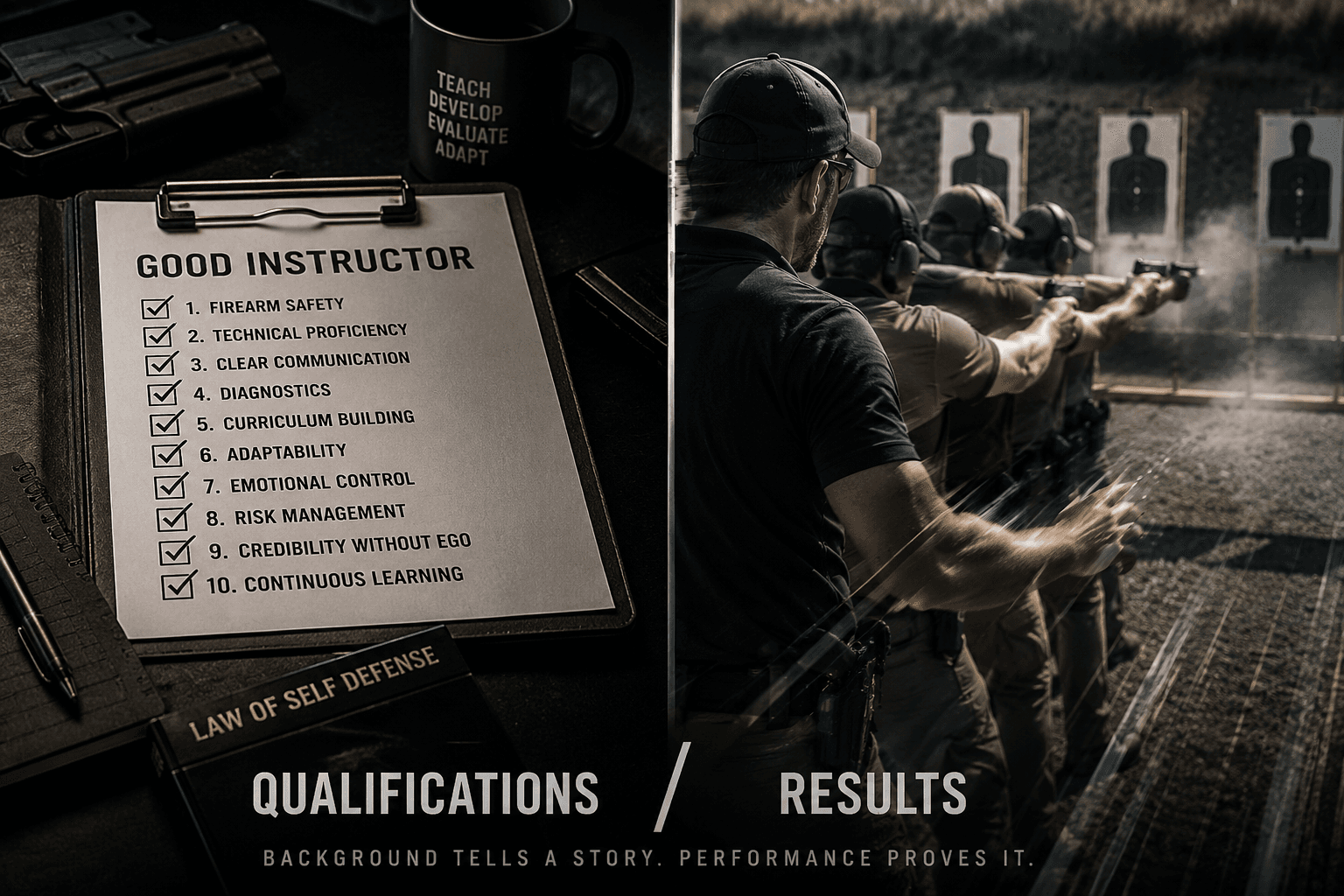
Here are the competencies that actually matter:
1. Firearm Safety. Non-negotiable, always enforced, corrected immediately and calmly when violated.
2. Technical Proficiency. The ability to demonstrate the skills being taught, at a high level, on demand.
3. Clear Communication. If you can't explain it simply, you can't teach it. Explain, then demonstrate.
4. Diagnostics. Spot what a shooter is doing wrong in real time. Identify root cause, not symptom. Prescribe the right fix.
5. Curriculum Building. Skill development is progressive. Instructors build it logically without overloading students.
6. Adaptability. A first-time nervous shooter and an experienced professional require entirely different approaches. Effective instructors modulate.
7. Emotional Control. Instructors set the tone. The best ones are calm, confident, and steady, especially when something goes wrong.
8. Risk Management. Constant layered thinking: positioning, spacing, student readiness, environmental factors, emergency medical plans.
9. Credibility Without Ego. Students need to trust you. The best instructors are approachable. Correct without belittling, and teach without performing.
10. Continuous Learning. Techniques evolve. Staying current through training, competition, or studying other instructors keeps your teaching effective.
Combat experience does not appear on that list. Every one of those competencies is learnable. All of them are measurable: reduced error patterns over repeated sessions; time-to-correction improving as an instructor sharpens their diagnostic eye. These aren't abstract ideals. They're observable outcomes, and they're the only honest scorecard.
Can they diagnose errors in real time? Can they produce repeatable results across different shooters? That's the standard.
What the Industry Needs
The firearms training industry cannot rely solely on reputation and background. Background cannot be a proxy for competence.
What’s needed is a consistent, objective way to capture, measure, and validate instructor effectiveness: not who trained you, but whether your students perform.
Background tells a story. Performance proves it.