
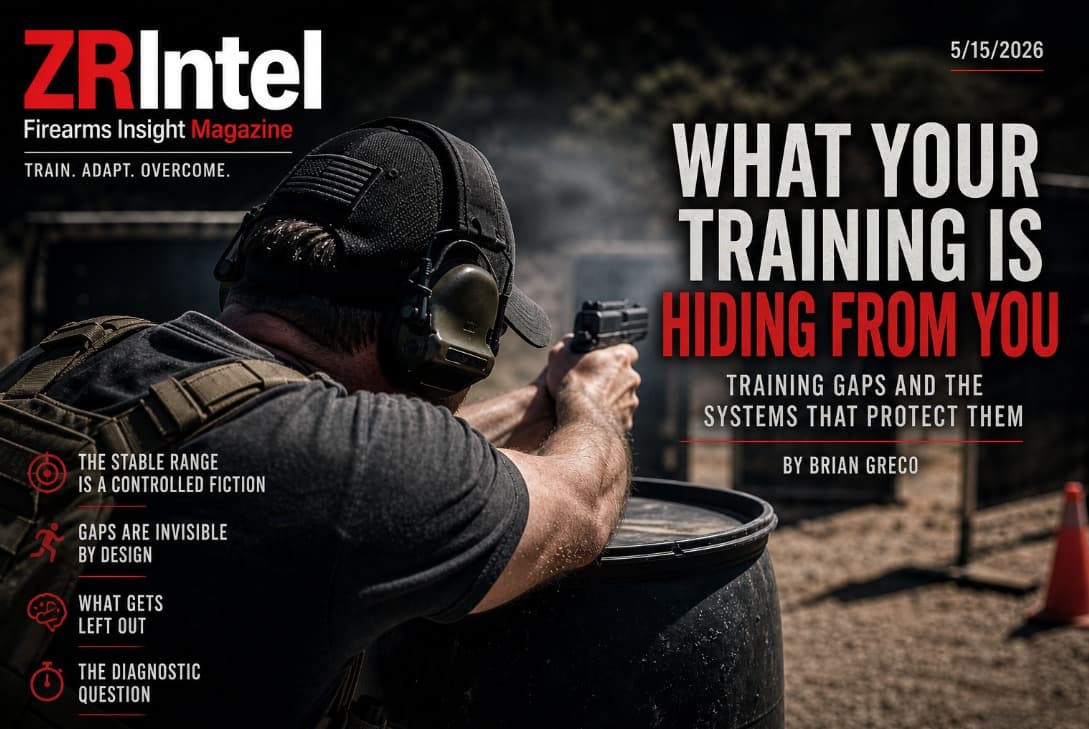
The shooter who concerns me most is not the one who knows he has gaps. It is the one who has trained long enough to feel like he does not.
That confidence is built honestly, over hundreds of hours on the range, accumulating the kind of proficiency that looks correct from every angle: the grip is solid, the sight picture clean, the groups tight enough to argue about. Then the conditions change. A par time gets introduced, or a movement requirement, or nothing more dramatic than a sustained sprint before the draw, and the thing that looked like mastery begins to come apart in specific, revealing ways.
Not a failure. Information. The only honest account of where a shooter actually stands.
THE STABLE RANGE IS A CONTROLLED FICTION
Firearms training, as most people practice it, is conducted in conditions that do not exist in the problems the training is supposed to solve. The range is static. The target is fixed. The sequence is known before the first round loads. Performance inside that structure can be excellent and still tell you almost nothing about what happens when the structure is removed.
Stress physiology does not care about the quality of your last group. When heart rate spikes and the decision cycle compresses, the subconscious does not retrieve your best range session. It retrieves the floor of what has been reinforced. A shooter who has only ever trained in calm, deliberate conditions has reinforced a skill that only functions under calm, deliberate conditions. The gap between that floor and the demands of a real encounter is not theoretical.
I have watched a shooter with ten years of consistent range work run a basic failure drill clean at 1.8 seconds, then get asked to sprint twenty yards and engage the same target at 1.8. His first shot went low left. His second missed the silhouette. His grip, his trigger press, his sight picture: all of it was there in training. None of it survived a forty-second elevation in heart rate. The mechanics were real. The training condition that tested them was not.
The system does not rise to the level of instruction. It falls to the lowest level of training that has been practiced under stress.
Every serious practitioner knows this. The problem is that knowing it and designing training around it are two different things, and most training environments are built for the former.
GAPS ARE INVISIBLE BY DESIGN
A training gap is not a hole you can see. It is an absence of demand. It lives in the space between what practice has asked and what a real situation will. Static-only work hides movement inefficiencies because movement is never required. Accuracy-only evaluation hides breakdown under time pressure because time pressure is never applied. Remove the decision layer from every drill and a shooter will never discover how performance degrades when a call has to be made mid-execution.
The result is a shooter measuring proficiency in the wrong currency. Hits on paper from a stationary position at a predictable distance are not a readout of real capability. They are a readout of range capability. Treating them as equivalent is where the plateau begins.
I have watched experienced shooters hit a wall they cannot explain. Time in, mechanics sound, but performance not climbing. In almost every case, the training system has stopped revealing anything new about actual deficiencies. They are getting better at what they measure and going nowhere on everything they do not.
WHAT GETS LEFT OUT
The gaps that remain are not mysterious. They are the ones that are uncomfortable or inconvenient to build into a standard session: movement under time pressure, transitions between positions when the body is already working, reloads executed during instability rather than from a clean stance, performance while genuinely fatigued. Not winded. The kind of systemic fatigue that changes how the hands and eyes coordinate.
Physical conditioning sits in its own category. Most shooters who train physically are building general capacity. General capacity has value. But being strong is not the same as being fast and coordinated during the specific demands of a shooting task. Speed, agility, and task integration under load are not byproducts of a good lifting program. Collapsing those two domains produces athletes who are fit but not prepared for what the work requires.
Performance in this context is the simultaneous integration of cognitive processing, physical movement, and technical execution, under conditions that do not allow recovery time between demands. Accuracy while fatigued and the ability to shift tasks without hesitation do not emerge from static training over time. They have to be deliberately built.
THE DIAGNOSTIC QUESTION
There is a difference between activity and preparation. Activity increases general capacity. Preparation is specific to a defined problem. The shift happens when the training question changes from what did I do today to what demand am I preparing to meet.
That question reframes everything. A shooter who goes home satisfied because the groups were good has answered the wrong question. The relevant question is whether any condition in today’s session would have revealed a gap if one existed. If the answer is no, the session maintained proficiency without testing it.
Effort is not the same as exposure. You can work hard inside a comfortable system for years and never find the edge of it.
Filling the gaps does not require a specialized facility. It requires intentional disruption of the conditions under which training normally occurs: movement before the shot, a time standard applied to an accuracy drill, position changes mid-sequence, a decision layer before execution. Each exposes something static practice conceals. The breakdowns that follow are not problems. They are the data.
MEASURING WHAT ACTUALLY MATTERS
The structural failure in most training systems is not what they ask of shooters. It is what they measure afterward. If the only metric is hits on paper, degradation under speed, instability, and fatigue stays invisible. The shooter improves within the tracked variable and stays flat on everything else. Over time, that produces a performance profile that looks solid on the range and fails when conditions change.
The metrics that matter are different: consistency of hit percentage as cadence increases, split-time degradation under physical load, decision accuracy when the correct action is not given in advance. Those numbers tell a practitioner what paper groups cannot. They show where the floor actually is.
Effective training runs two modes. One pushes past current limits to expose weakness. The other reinforces consistency within known capability. Without the first, growth stalls. Without the second, performance becomes unreliable. The relationship between them is not sequential. Both are always present, or neither works.
The objective is not maximum performance achieved once under ideal conditions. Reliable performance near the limit, under pressure, repeatedly. Real-world application does not select for your best day.
THE COST OF NOT LOOKING
Gaps in training are not theoretical. They exist in every system that does not actively seek to expose them. And they do not announce themselves until the conditions that reveal them are already in motion.
The shooter who has never been required to perform under the conditions that produce failure has not demonstrated those failures do not exist. He has demonstrated that his training never asked. There is a version of that shooter who has logged ten thousand rounds, passed every qualification, and still carries a performance ceiling he has never once encountered, because no session was designed to find it.
False confidence built on uncontested proficiency is not a character flaw. It is a design outcome. The training system produced it. The training system will protect it, right up until the moment it cannot.
A gap in training is not the absence of effort. It is the presence of a system that was never built to find one.