
I AM NOT THE INSTRUCTOR
I have not spent my career building curricula or running qualification courses. I’ve spent it in the military, corrections, protection work, emergency response, and risk analysis environments that absorb the output of training programs after the certification is done and the paperwork is filed.
That perspective matters. The people designing training programs are not always positioned where the consequences land.
What I see from here is consistent.
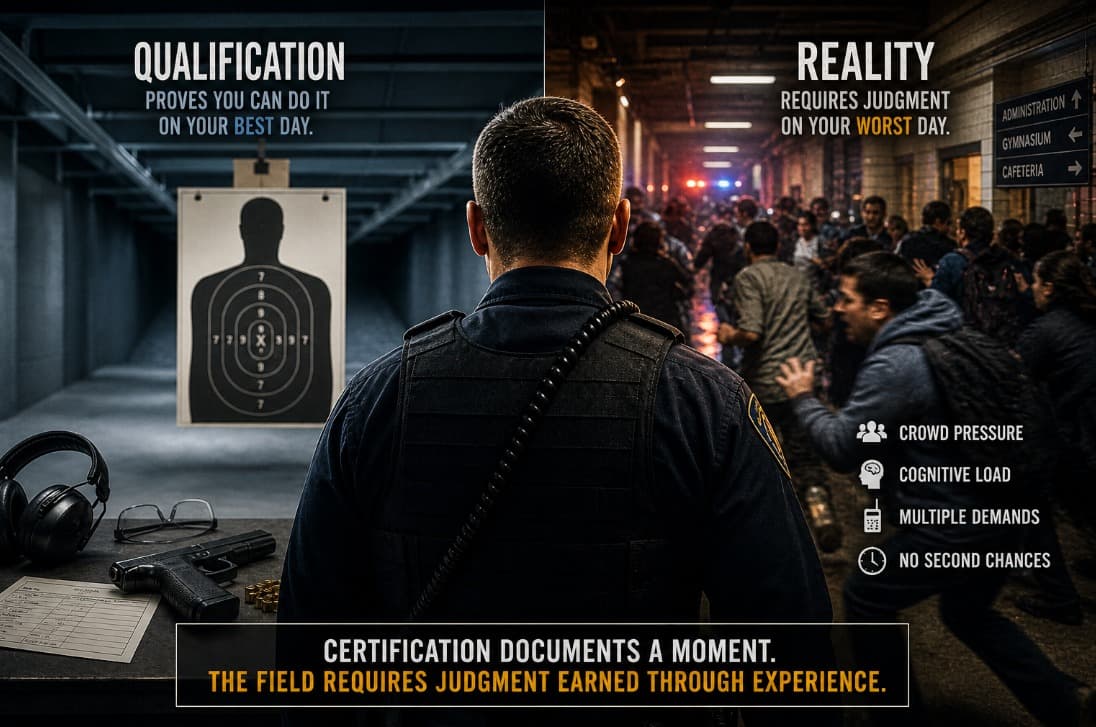
The person who passed their qualification six months ago freezes when the situation stops cooperating. The officer who scored clean on a static course cannot manage a crowded corridor with a principal who isn’t moving as expected, a crowd pressing from the wrong direction, and a radio call coming in at the same time. The security professional who was certified as ready makes a decision under pressure that no amount of training time prepared them to make because that time was never designed to prepare them for it.
This is not a critique of instructors. Most are serious professionals doing important work within a system that was not designed to produce what the field actually requires. The problem is structural and the people who see it most clearly are often not inside it.
WHAT THE FIELD SEES
In corrections, you work in close quarters with people under sustained stress many of whom are mentally ill, have violent histories, and have the time and motivation to manipulate you. It is an environment that consistently produces stress, instability, and violence. Situations shift quickly and without warning. Inmates commonly have access to weapons, cellphones, drugs, and, less commonly, even firearms.
The officer who arrives certified but underprepared rarely fails dramatically. The failure shows up in the margins hesitation at the wrong moment, unnecessary escalation, decisions driven by strict adherence to protocol rather than a reading of what’s actually in front of them.
You won’t see that on a qualification record. You’ll see it in incident reports, grievances, and outcomes that escalated and required more force than the original situation warranted.
The same pattern shows up in static security roles. A guard assigned to a fixed post encounters an unexpected situation an argument that escalates, or a sudden movement they didn’t anticipate and has to make a decision without the structure they trained in. The training prepared them to pass a standard, not to interpret and manage a situation that doesn’t follow a script.
In protection work, the firearm is the last step in a sequence that begins with observation, moves through assessment, and depends on the ability to exercise good judgment under high cognitive load. A protection professional managing a principal in a crowded environment is tracking movement, reading behavior, communicating with a team, and making decisions with incomplete information all in real time.
The firearm is always present. It is more rarely the solution to the problem being solved.
Both corrections and protection roles require firearms qualification and often use the same course of fire. Yet a static qualification only confirms someone can hit a target under controlled conditions on a given day. It does not confirm they can manage everything happening around them while moving, while the target is moving, or while multiple demands compete for attention.
In emergency response and disaster environments, the same gap appears. The person who performs well in controlled drills encounters a real incident and discovers that the cognitive load is fundamentally different. What carries people through is not memorized procedure it is judgment built through exposure to conditions that don’t cooperate.
That gap becomes most visible when priorities compete. A team may have to choose between reaching a single victim who is farther away but accessible with minimal resources, or committing to a closer site with multiple victims where meaningful progress cannot begin until additional equipment arrives. The decision is not procedural it is situational, time sensitive, and often made with incomplete information.
That kind of judgment is difficult to simulate in controlled environments. It has to be developed through exposure to scenarios where trade offs are real and outcomes (and consequences) are uncertain.
Certification documents a moment. The field requires judgment earned through experience and experience is a pattern of behavior across conditions that produces consistent outcomes.
Those are not trained or measured in the same ways.
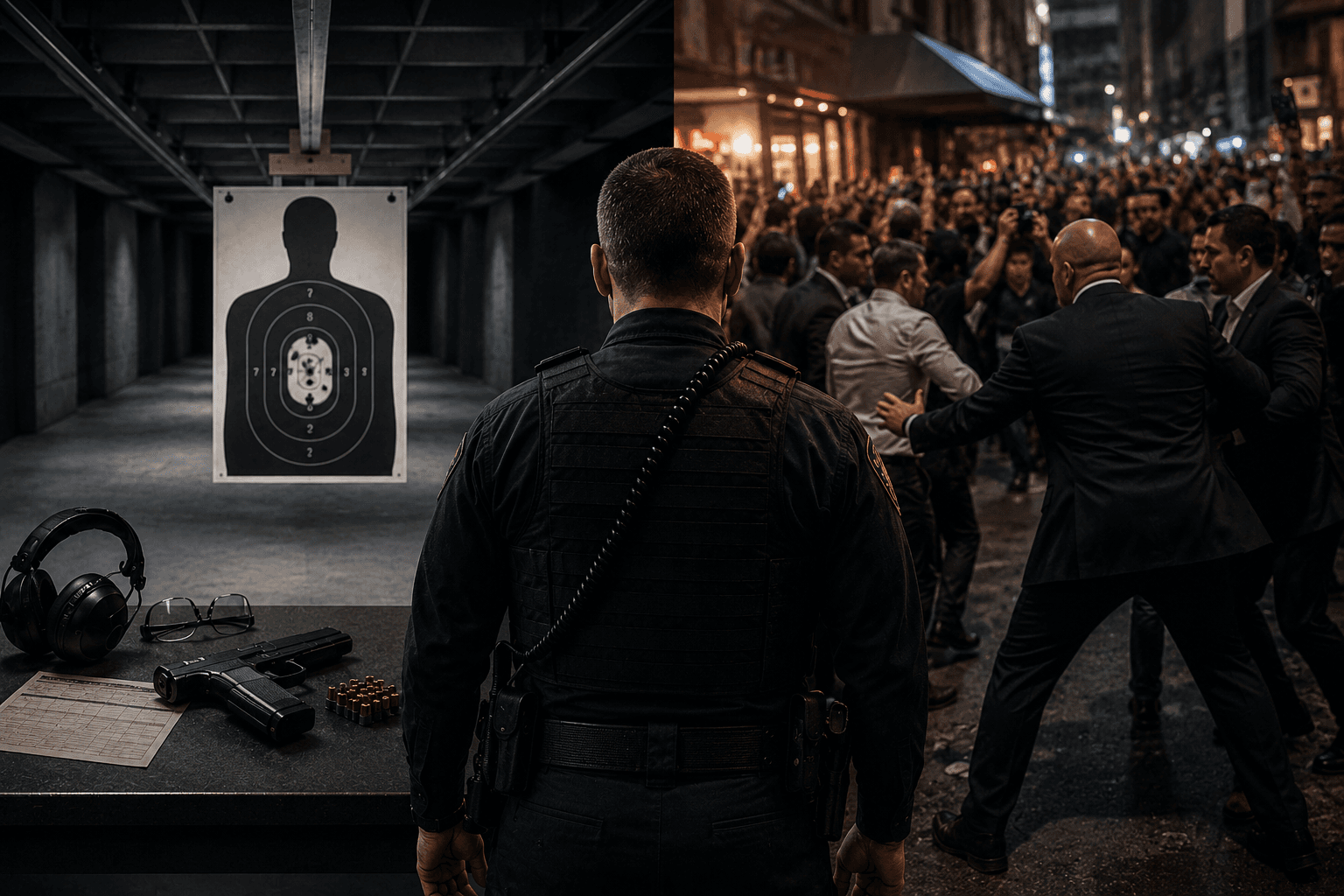
Certification documents a moment. What the field requires is a pattern of behavior across conditions. Those two things are almost never measured by the same instrument.
THE MEASUREMENT PROBLEM
Training programs are built to verify a minimum standard at a specific point in time not to track capability over time or measure performance under realistic conditions.
That is a design choice, built around standardization and production.
And that choice has consequences that are visible from the field, even when they aren’t visible from inside the training system.
In threat assessment, the critical question is not whether someone reached the correct conclusion it’s how they got there and whether they can articulate that reasoning. A conclusion without reasoning isn’t assessment. It’s a guess supported by confidence.
The same principle applies to firearms training.
A passing score without any record of how someone performs under fatigue, competing demands, or conditions that evolve faster than protocol anticipated tells you very little about what happens next.
Training leadership sees the scores the system produces. They don’t see how people behave when the controlled conditions disappear.
Until that changes, the gap between what gets measured and what the field actually requires will continue producing outcomes the training record never predicted and the system cannot measure.
WHAT GETS REWARDED
A program that rewards the highest qualification score is selecting for performance on a static course under no pressure. That is a real skill but it is not a skill that is predictive of successful outcomes in corrections, protection work, or emergency response.
What determines outcomes is the ability to read a situation that isn’t cooperating, manage competing demands, and make and later articulate defensible decisions with incomplete information and no pause button.
Those skills don’t develop from repeating the same course of fire once every other year. They develop through regular use and exposure to conditions that actually require them.
When organizations consistently reward one type of performance over another, they shape what people optimize for what gets practiced, what gets taken seriously, and what gets treated as professional development.
Many programs in this space are selecting for one capability while describing themselves as building another.
That gap matters.
There is also a growing pattern in private security that deserves attention: increasing rigidity in how people define their role and tactics. That rigidity is often shaped more by identity than by evidence. As it increases, adaptability decreases and adaptability is what keeps people safe.
That degradation won’t show up on a qualification record. It shows up later.
Most programs are selecting for the wrong capability while describing themselves as building the right one. That gap is not accidental.
WHAT THIS LOOKS LIKE FROM HERE
This is not an argument against qualification standards or against instructors. It is a description of what the output of the current system looks like in the environments that receive it.
Training programs have access to qualification records. They do not always have access to what happens after. The incident report goes somewhere else. The grievance goes somewhere else. The outcome goes somewhere else. And they need access to those outcomes to adapt training and ensure people are better prepared when they exit the training pipeline.
From where I sit, those outcomes are not random. They are patterned. And the pattern points back to the gap between what training is designed to produce and what the field requires.
Closing that gap starts with looking downstream.
Not at pass rates. Not at attendance.
At performance after certification what people do when the situation stops cooperating.
That information exists. It just isn’t reaching the people who design the training.