
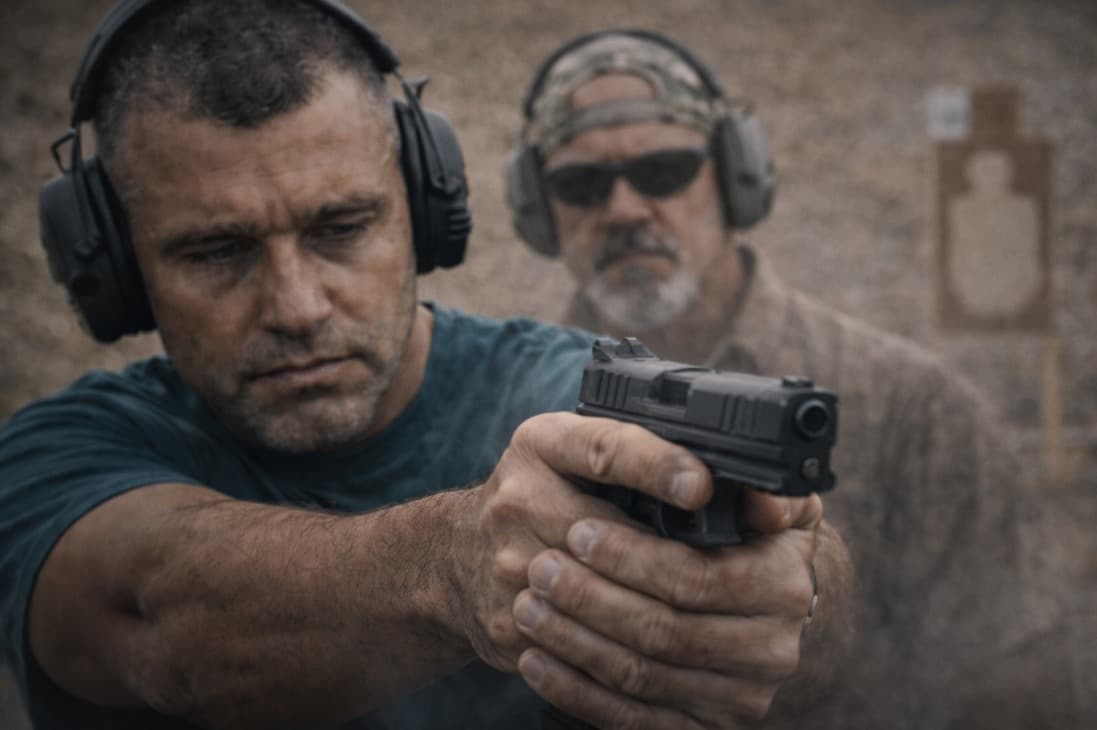
I watched an IPSC champion point a loaded pistol near his own temple and negligently pull the trigger. His hair blew upward. His blood pressure dropped. He was among the best competitive shooters in the world, and he nearly killed himself on a training range because he stopped consciously managing what his hands were doing. That is the part people miss when they hear this story. They focus on the near miss. What matters is the mechanism. His safety programming had gone silent. He was running on autopilot, and autopilot has no error correction.
I have spent over four decades training shooters across every domain this craft touches, from soldiers preparing for close quarters battle to civilians who carry daily and may never fire in anger. The beginner is safe. The intermediate is dangerous. The beginner knows what he does not know. The intermediate has accumulated enough repetitions to feel competent but not enough to have stress-tested that competence against real conditions. He has stopped paying attention because the work no longer feels hard. That is precisely when the gaps in his programming become lethal.
Advanced techniques are the basics mastered. Nobody is impressed with how fast you can shoot and miss.
Most firearms instructors approach performance problems by isolating the symptom. The grip is wrong, so they fix the grip. The stance is off, so they adjust the stance. The trigger press breaks early, so they drill the trigger press. This treats marksmanship as a collection of separate physical tasks when it is nothing of the sort. Marksmanship is a nervous system program. It has to be built the way any motor program is built: in sequence, without error installed at the foundation, and with enough correct repetition that the sequence runs below the threshold of conscious thought. Fix components in isolation and you may correct the surface error while leaving the deeper architecture untouched. That architecture is what survives contact with a real threat.
Most training failures are not caused by stress. They are revealed by it. They were installed long before, in training, by instructors who never saw the error because the error only surfaces when the stakes are real. Combat marksmanship is 80 percent dry fire. In most cases, the first live round should not be chambered until form and movement are clean. Any imperfection embedded early is not a bad habit. It is code written into the nervous system. That code does not disappear with more rounds downrange. It gets suppressed by correct repetition, and suppression costs far more than clean installation would have. Under genuine stress, at close range, with a real decision driving the sequence, suppressed code resurfaces. That is not a character failure. It is neuroscience, and it belongs to the instructor.
I describe the architecture of combat shooting in three terms: chunking, chaining, and branching. Chunking converts a sequence of conscious decisions into one fluid movement. Chaining links those movements into a continuous loop from presentation to follow-through. Branching builds deliberate off-ramps within that loop for malfunctions, multiple threats, and unexpected contingencies, each tying back into the primary sequence without breaking it. The goal is a program that runs without consuming conscious attention, so that attention goes where it belongs: reading the environment, assessing the threat, and deciding whether to fire at all. Multi-tasking is a myth. The brain task-switches, and task-switching must be trained in sequence or it collapses under pressure.
Flinching is not a technique problem. It is a confidence problem wearing technique’s clothes. Fix the mechanics and the flinch moves. Fix the confidence and it disappears.
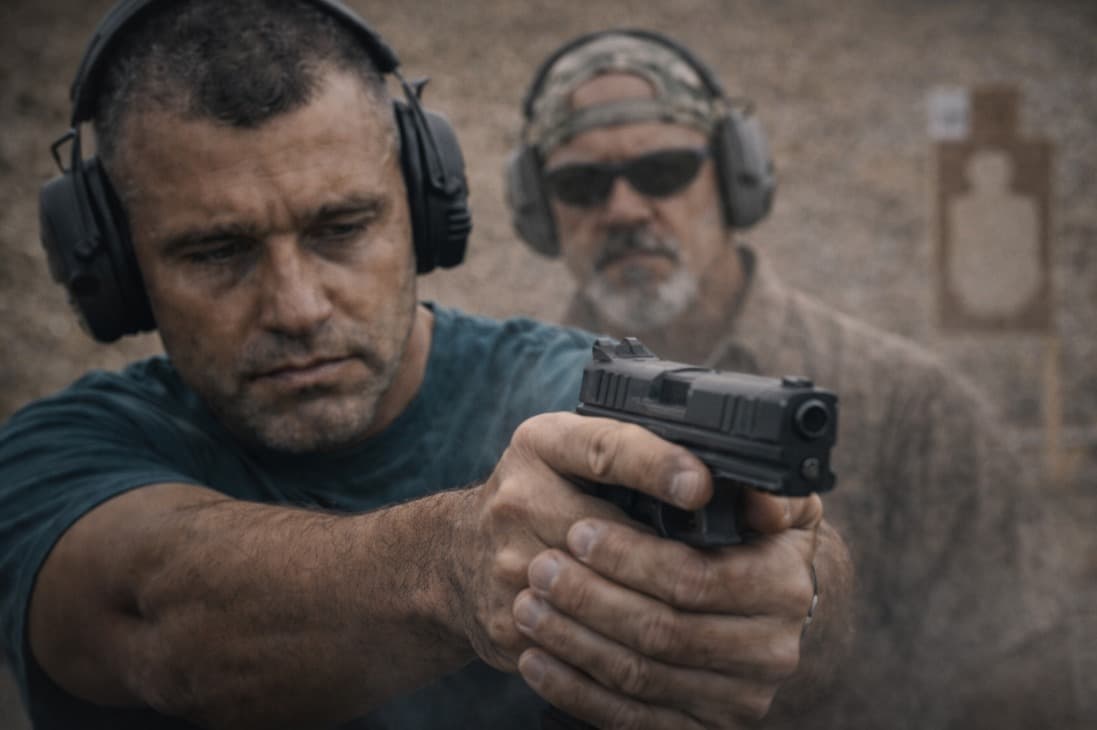
Flinching is the most misdiagnosed performance failure in this industry. Most instructors see it and reach for a mechanical correction. Sometimes the flinch diminishes. More often it migrates, appearing in a new form once the obvious trigger is removed, because the root was never touched. Flinching is an anticipatory reflex driven by the amygdala. The shooter’s nervous system has assessed its grip on the outcome as uncertain and initiated a protective response before the shot breaks. The fix is not mechanical. It is command confidence, built through thousands of repetitions in which the shooter controlled the firearm exactly as intended. When a shooter genuinely knows he is in control, the amygdala receives a different signal. The hijack does not happen.
The support hand grip is where most instructors leave real performance on the table, and most of them do not know it because they were never taught otherwise. The support hand is not a brace. During rapid fire, it is the primary driver of muzzle return. A properly engaged support hand drives forward pressure into the frame, countering muzzle flip and pulling the gun back onto the target line faster than the firing hand can accomplish alone. A lazy support hand, one wrapping the firing hand rather than actively loading into the grip, bleeds time from every round in the sequence. Put a shooter on a timer. Watch the splits widen. Watch the group climb. That is not a stance problem. That is a support hand problem, and it compounds with every shot fired.
Kinesiology, psychology, and neuroplasticity are one system. A shooter with clean mechanics but an unmanaged stress response will degrade under load. A shooter with high confidence but errors embedded at the foundation will revert when it matters. Neglect any layer and you compromise all of them. This is where most firearms instruction falls short, not in the mechanics being taught, but in the knowledge required to understand what governs whether those mechanics survive a real encounter.
Real stress is the variable that exposes everything. Anyone can shoot well on a flat range with no consequence attached. Defensive shooting, combat shooting, any shooting where the result is permanent, introduces a physiological state that is categorically different. The amygdala activates. The reticular activating system narrows perceptual focus. Heart rate climbs. Fine motor degradation begins. Programs that ran cleanly in training start to break down. The only preparation for that state is training that actually produces it, genuine physiological arousal with elevated heart rate, time compression, and consequence for failure. That state can also be built and regulated internally through autogenic conditioning, a practice of directed self-talk and controlled breathing that trains the autonomic nervous system to perform under arousal rather than shut down. Elite operators develop versions of this through repetition and survival. The ones who develop it deliberately hold a measurable edge when the situation stops being a drill.
This is science applied to the art of killing. The instructor who does not understand both is teaching half a discipline.
When the conditions are right, the change in a student is not gradual. It is a switch. When a student understands how to read and calibrate his own nervous system, and when the instructor is skilled enough to facilitate rather than simply correct, performance shifts in ways that surprise even experienced coaches. The student has to know, not believe, not hope, but know, that what changes comes from within, through fundamentals applied with precision rather than volume. That is the line between a shooter who improves and one who transforms.
Master the basics. Not as a phase you pass through. As the foundation you return to every time you pick up a weapon. When everything fails in a real engagement, and things will fail, two things remain: front sight picture, and press.
Everything else fails first. These do not.