
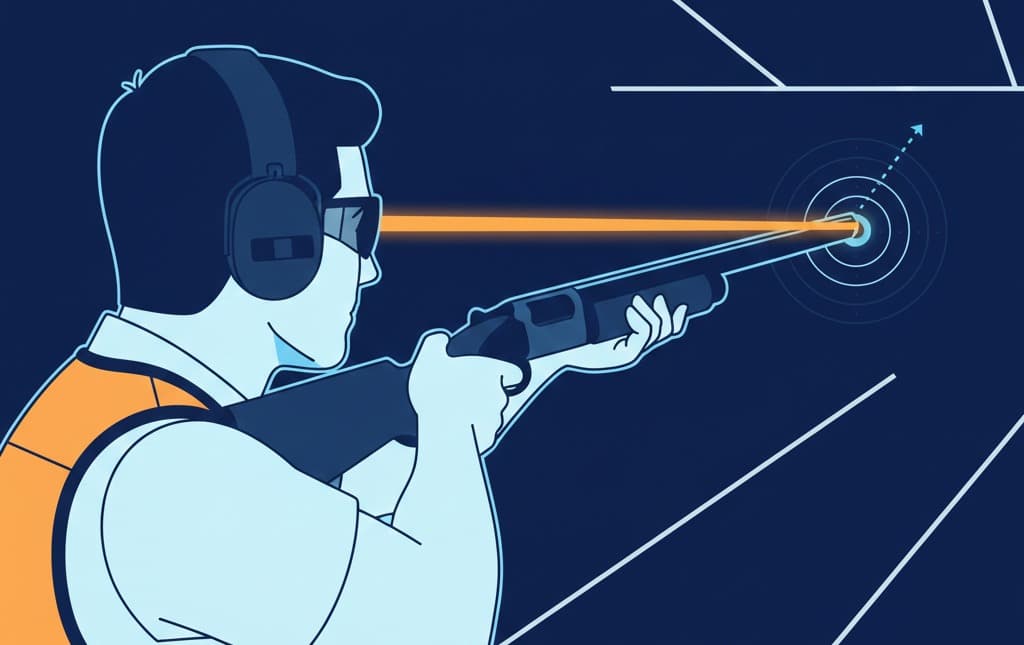
I've been standing behind students on the firing line long enough to know the look. The stance is right. The grip is solid. The trigger press is clean. And the shots are still pulling predictably, consistently, frustratingly, in the same wrong direction. When I ask whether they've ever had their eye dominance tested, I usually get a blank stare.
Cross-eye dominance—the condition where your dominant eye sits on the opposite side from your dominant hand—affects roughly one in three people. That's not a fringe issue. Most of them have been shooting for years with a problem that no one has ever properly diagnosed. As someone who is cross-eye dominant, I know it is frustrating, and unless and until you fix it, it will continue to plague your shooting.
The Thirty-Second Diagnosis
The tests are straightforward and every instructor should run them on new students before anything else:
- The Triangle Test: Form a small opening between your hands at arm's length, center a distant object, then close each eye alternately.
- The Pointing Test: Point at an object with both eyes open, then close each eye. Your dominant eye is the one where your finger stays aligned.
Once you've confirmed cross-dominance, the path forward depends on the platform and the student. There are three primary approaches:
1. Switching Hands (The Durable Solution)
The most durable long-term solution is to train from the dominant eye side. A right-handed shooter with a left-dominant eye learns to run the gun from the left side. You are working with your visual system rather than fighting it. Muscle memory will protest, so start with dry fire at close range with no time pressure.
2. Occlusion (The Training Tool)
For students not ready to switch hands, a small piece of translucent tape on the dominant-eye lens of shooting glasses is a legitimate training tool. It forces the brain to prioritize the eye behind the sights without fully closing off peripheral vision. This works particularly well for shotgun sports where the relationship between eye and target is unforgiving.
3. Head Rotation (The Handgun Workaround)
Handgun shooters have an accessible workaround: a slight rotation of the head toward the dominant eye. This brings the dominant eye into alignment with the sights. Consistency is key; a head position that varies from shot to shot introduces too many variables.
I recently spoke with Scott Jedlinski of Modern Samurai Project who has advocated that during pistol shooting, one bring the pistol up under the dominant eye instead of moving the head in line with the dominant hand. I am working through it... the jury is still out, but I am trying a new method.
Platform Specifics
Handguns: The most manageable. Geometry allows for head adjustments, and switching hands is more achievable than on a long gun.
Rifles: The hardest case due to fixed cheek welds. While iron sights are unforgiving, red dot optics have changed the calculus, as they are considerably more forgiving of slight lateral eye position variations.
Shotguns: This is where cross-dominance does the quietest damage. I struggled for a long time shooting trap; I tried changing shoulders but found it too awkward. For me, occlusion was the only way to go.
The Coaching Principle
Identify the specific visual interference before prescribing the solution. An instructor must also manage the patience variable: a student who has been shooting cross-dominant for years has built thousands of repetitions of compensating movement. The adjustment period will feel like regression before it feels like improvement.
Document the process. Baseline accuracy data from before the intervention gives the student objective evidence of progress during that rough middle phase.
Cross-eye dominance is not a disqualifying condition. What separates high-level shooters from frustrated range-goers is not talent or hardware—it's a diagnosis that came early and an instructor who knew what to do with it.