
Early in my career as a U.S. Border Patrol Agent, I was given access to a FATS machine at the station. FATS was the precursor to every computer-based simulation system in use today. Most agents treated it as a break from real work. I treated it as extra range time. I liked training. I liked shooting. And I had enough humility to understand that I had arrived at the job as a science nerd and an EMT, not as a trained law enforcement officer. I had a lot of ground to make up. So I jumped into every session I could get.
After running the same scenarios over and over, I started noticing something. I could read the cues in the video well enough to know where the scenario was branching before the threat ever materialized. I knew whether I was going to have to shoot before the subject made a move. That was not skill, not yet. It was pattern recognition built from repetition, and it was beginning to change the way I processed what I was watching.
One day, a scenario was clearly tracking toward a shootable threat. The subject reached behind himself and I fired. First shot broke before the gun was visible. Second as it came into view.
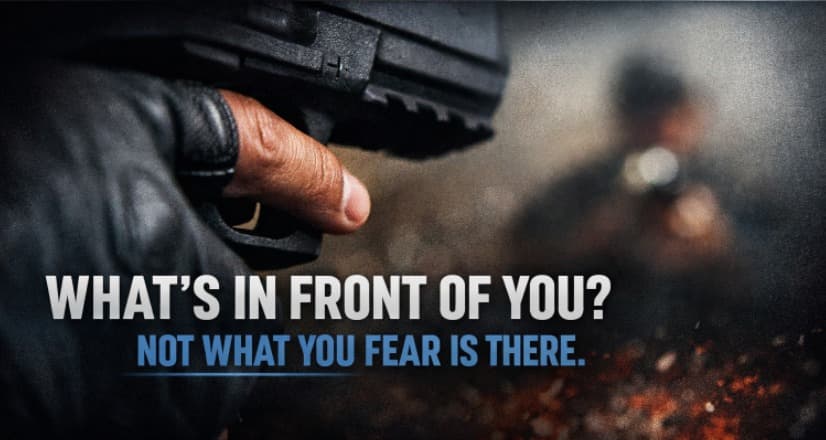
I received a thorough debrief. The instructor was right to give it. But what that session revealed was something I would spend the next twenty-five years trying to understand and teach: when the mechanics of shooting become automatic, the brain gets freed to process what is actually in front of you. Not what you fear is there. What is actually there. Every rep you put into making the draw, the sight picture, and the trigger invisible is a rep you are putting into perception. That is the investment most training programs never account for.
Each of us only has so much cognitive processing capacity at any given moment.When that capacity is occupied by the machinery of shooting, there is almost nothing left to read the environment. The mechanics have to become invisible before the perception can become reliable. That is the one thing.
A few months after those FATS sessions, I was working a sensor hit near the Rio Grande. We typically approached with a firearm in hand because you had no idea who was on that trail. I spotted three people in the brush, identified myself, and ordered them to stay still. One man turned toward me. His hand came up. I saw a reflection. I started pressing the trigger.
My brain said one word : Sunglasses.
He was holding a pair of mirrored sunglasses in his fist. The light caught the lens. Because the mechanics had become background, my brain had enough room left to process what I was actually seeing. I got off the trigger in time. He never knew how close it was.
That moment did not happen because I was talented. It happened because enough repetitions had pushed the shooting mechanics far enough into the background that perception could do its job. Pull out any piece of that preparation and I am not sure the outcome is the same. The academy pushed observation. My field training officers pushed observation harder. I had pushed myself physically because being out of shape means thinking about your legs when you should be reading the brush. All of it fed the same result: the mechanics went quiet, and perception had room to work.
Every unresolved mechanical question is a direct tax on the cognitive budget you need in that moment. An uncertain draw. An unconfident trigger press. Anything that is not yet wired in pulls processing capacity away from what you are actually looking at.
Training that does not reduce that tax is adding to the problem, not solving it.
Here is what I watched happen over twenty-five years: most law enforcement firearms training stops at qualification. Get the officer to the standard, document it, move on. When I started at Border Patrol, we had to beg for a box of ammunition to practice on our own. That improved over time. But the underlying logic stayed the same. The qualification was the destination, not the starting line.
Once an officer qualifies reliably, the training has to change its question. Not: can this officer hit the target? But: how fast, how consistently, and does that hold under pressure? A shot timer answers a different question than a scored target. The qualification records a date and a pass. The timer records a performance. One is a credential. The other is evidence. When you introduce timed standards into training, shorter splits, longer distances, consistency tracked across sessions, you are asking how sharp this officer actually is right now, and whether that sharpness is holding over time.
The technology to capture this has existed for years. Shot timers have been standard range equipment for decades. What most agencies lack is the infrastructure to make that data verifiable and portable. A record that travels with the officer. That reflects current readiness rather than last cycle's pass. That holds up when the hard questions get asked in a review or a deposition. The hardware is not the problem. The documentation layer is. And until that layer exists, the qualification document remains the only record anyone has, which means it is being asked to answer questions it was never built to answer.
I have been a Border Patrol Agent, a Secret Service agent, a Regional Training Program Manager, and an instructor at the Secret Service Academy. In every one of those roles, what separated the officers I trusted from the ones I worried about was never how much they knew. It was how much of what they knew had disappeared into reflex. Knowledge takes up space. Reflex does not.
The brain has a fixed budget. The window for a correct decision does not wait. The only way to do more with that budget is to spend less of it on mechanics and put everything that is left into seeing clearly.
The man with the sunglasses is still alive because enough of that work had already been done before I walked down that trail.
Not instinct. Not luck. Work done before the moment arrived
That is what training is actually for.