
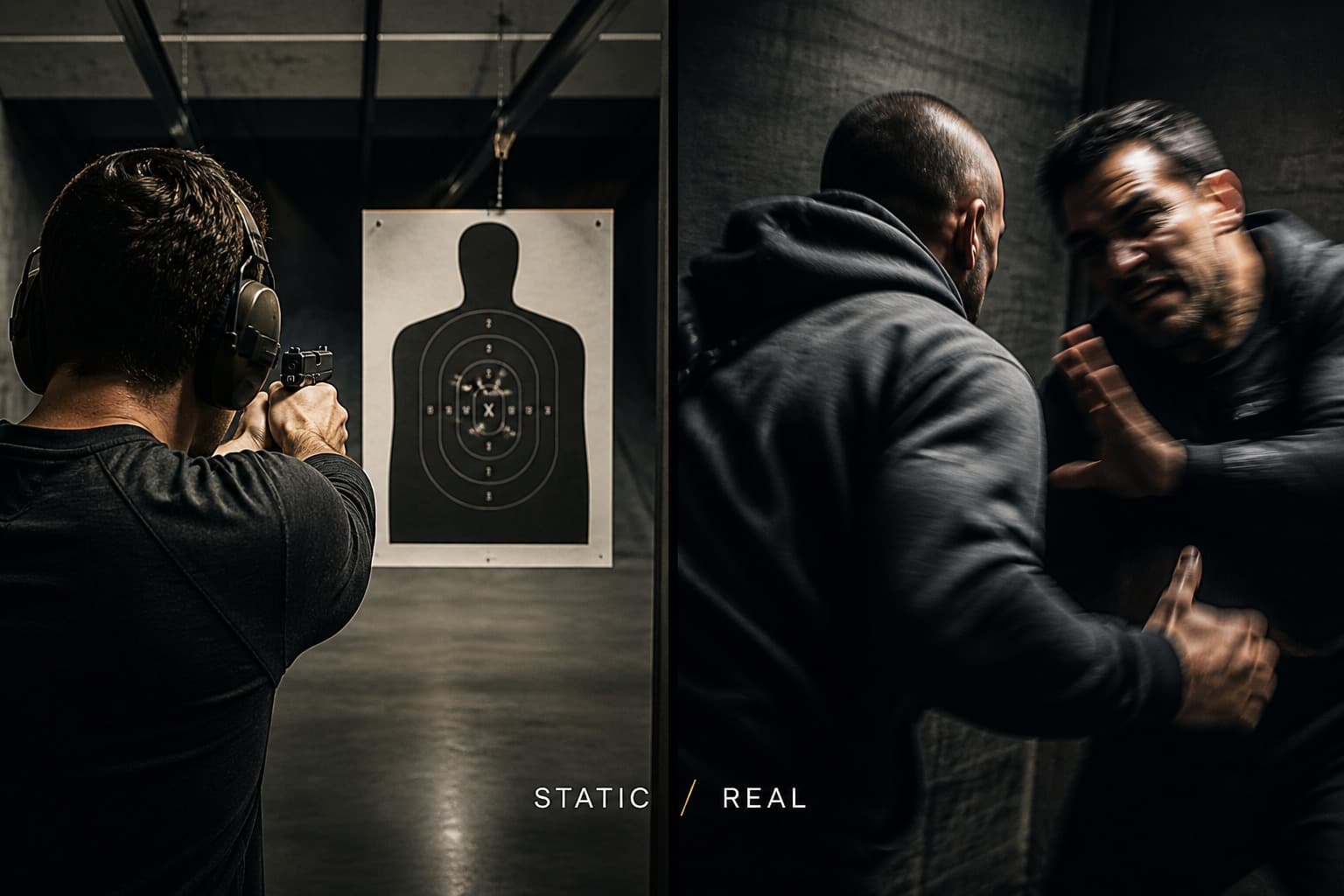
Most people train for the gun. Almost no one trains for the fight.
Walk onto any range and you'll see tight groups on clean targets. Shooters track progress in fractions of an inch, comparing patterns, chasing consistency. They invest in better gear, better ammunition, better optics. They study trigger mechanics and grip pressure and sight alignment until those things become second nature. That work is real. Technique has to be built somewhere, and the square range is where it gets built. The structure, the repetition, the controlled conditions that's how raw mechanics become reliable habits.
The problem is what people believe after they leave.
They start treating those tight groups as a proxy for readiness. They walk off the range assuming something transferred that the hours invested, the consistency, the clean targets somehow mean they're prepared for a real confrontation. That assumption is understandable. It's wrong. The square range and real violence are two entirely different problems. One rewards patience, precision, and a calm mind. The other ignores all of it.
Real violence is fast. Faster than most people expect the first time they're exposed to anything resembling it. It's close most defensive encounters happen at distances that would be unremarkable in a conversation, not across a range bay. And it's already happening before your brain has finished deciding what to do. There's no signal. No buzzer, no ready position, no controlled breathing cycle. One moment you're somewhere doing something, and then someone is already on you.
The root word of gunfight is fight, not gun — and most people have never been in a real fight. Not a push in a bar, not a schoolyard scuffle, but something where another person is genuinely trying to hurt you and moving fast to do it. That experience changes what you think is possible. You learn how quickly the body locks up, how fast distance collapses, how completely a plan evaporates. You may not get to your gun. You may not have time to process what's happening before you're already responding. The other person is not waiting on you.
One of the biggest gaps I see in students across all backgrounds, all experience levels is the assumption that it'll happen on their terms. They picture recognizing the threat with time and distance to respond cleanly. They imagine controlling the pace, moving to a position of advantage, executing something that resembles what they've practiced. That picture is almost never what reality looks like. The attack comes faster than expected, from closer than expected, and it starts before the defender has mentally switched from normal life to survival mode. If you find yourself in a fair fight, your tactics have already failed you.
Now ask yourself something: when was the last time you trained something that didn't go the way you planned? Not a drill that was difficult a drill that broke down. Where your draw was wrong, your position was wrong, your read of the situation was wrong. If the answer is rarely, or never, that's the gap. That's exactly where real violence will find you.
What matters most in the early moments of a real encounter isn't marksmanship. It's awareness but not awareness as an abstract concept. Awareness as a practiced skill: noticing behavior that doesn't fit the environment, reading a space before you're committed to moving through it, recognizing the pre-violence cues that exist in almost every attack before contact is made. A shift in body language. Someone closing distance without reason. The feeling that something is off before you can name what it is. That recognition — trained, not assumed is what ends most encounters before they start. Avoidance is always the better outcome. Not because the defensive option doesn't exist, but because no situation you survive comes without cost.
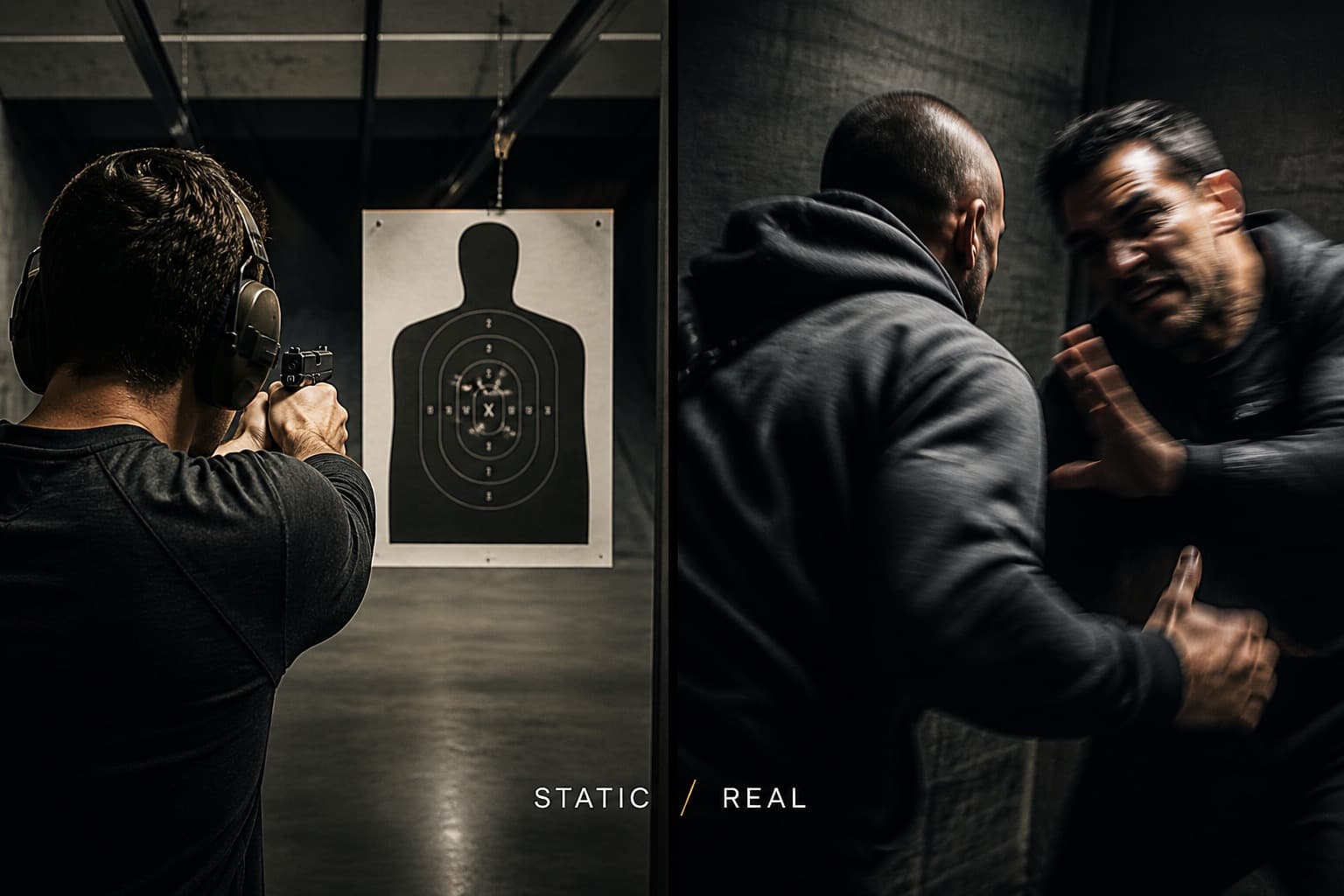
Distance, positioning, timing, and decision-making shape everything that follows. These get almost no attention in most programs, and they matter far more than groupings or split times. The ability to move, to create space, to not be where someone expects you to be these are the variables that determine whether a confrontation ends quickly or turns into something you have to survive on the back foot. Marksmanship enters the picture only after everything else has already broken down. By the time you need it, awareness has failed, distance has collapsed, and you're deep in an encounter that wasn't supposed to happen. Even then, it only matters if you can reach your weapon and create enough room to use it.
The mechanics still need to be there. When things fall apart, you fall back on your fundamentals — that's the actual return on investment from square range work. Not that the range prepares you for violence, but that the basics become automatic enough to survive the chaos. A compromised draw under maximum stress is worse than no draw at all. The fundamentals are the floor. The problem is treating the floor like a ceiling.
Almost no one trains the breakdown. The speed of it, the physical pressure, the experience of a real plan disintegrating in the first second of contact. No one who has been in a genuine confrontation says it went the way they imagined. The plan doesn't survive first contact with someone who hasn't agreed to it. That's not philosophy it's what happens every time, without exception. If your plan fails in the first second, what do you actually do next? If you don't have an answer to that, your training hasn't finished.
Force-on-force training starts to close that gap when it's run properly. The equipment doesn't matter. What matters is the other person a human being who is thinking, reacting, and making their own decisions in real time. Someone who doesn't stand still, who doesn't cooperate, who doesn't care about your technique. That changes everything: how you move, how you process information under pressure, how fast you realize that your mental model for how this was supposed to go is worthless. There is no classroom substitute for that. It has to be felt.
There's also a mindset problem most civilian shooters never fully confront. They're training to win. To execute cleanly, to dominate the situation, to be the best performer in the scenario. That's the wrong goal entirely. A defensive encounter is not a competition. The goal is to survive — to break contact, create distance, and get out by whatever means are available. Survival doesn't look clean. It's not efficient or elegant. It doesn't necessarily look like good shooting. It looks like whatever it took to still be breathing.
The difference between training to win and training to survive shows up in the decisions people make under pressure where they move, what they prioritize, when they disengage. Those are not cosmetic differences. They determine outcomes.
Marksmanship matters. Mechanics matter. The square range builds something real and dismissing it doesn't produce better defenders — it produces people who've forgotten they need to be able to hit something when the moment comes. But shooting well is a prerequisite, not the answer.
If your training only works on a range, you're not training for a fight. You're training for a place where nothing fights back.
Those are not the same place.
Train to fight.