
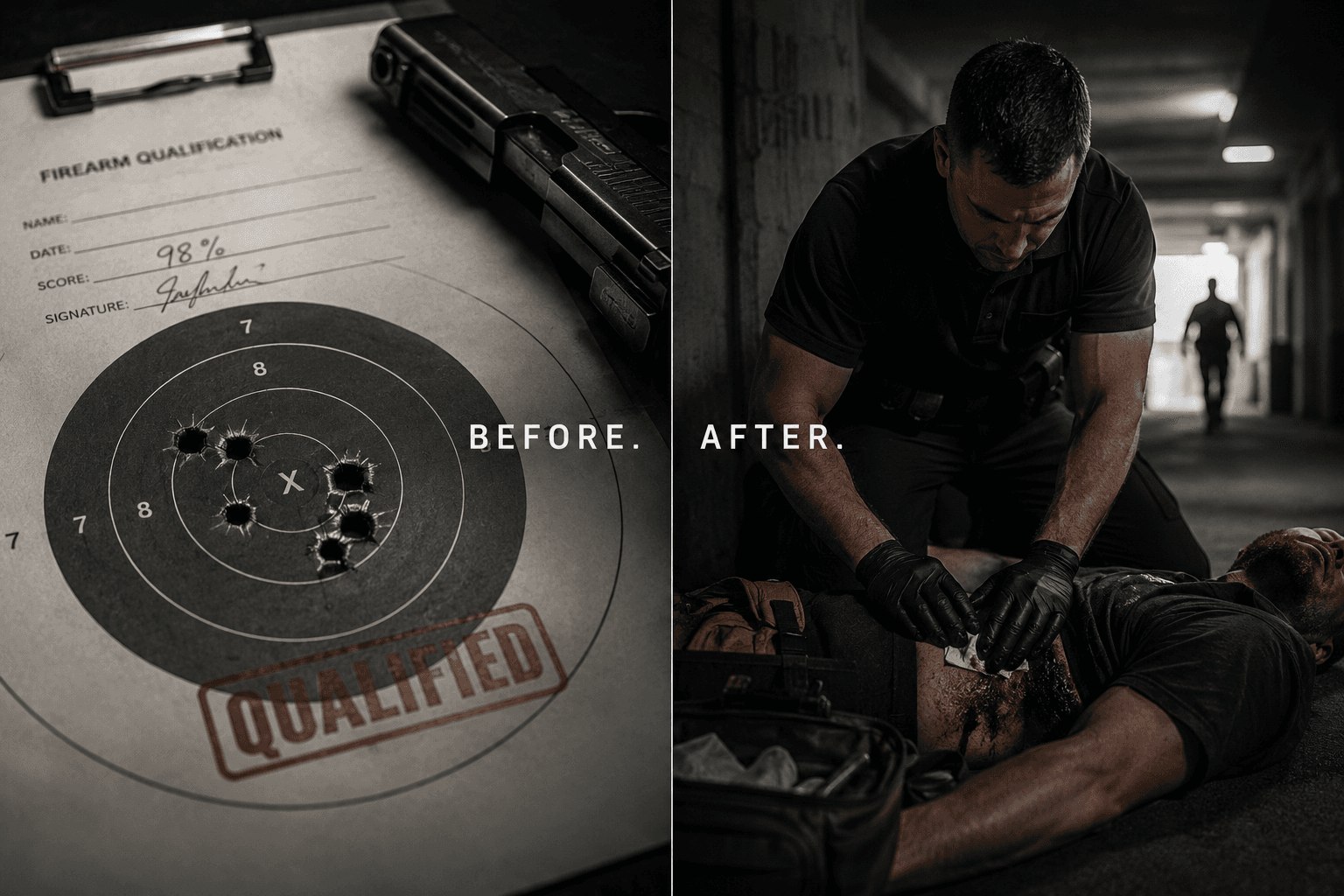
The security officer had passed every required test. His firearm qualification was current. His certifications were in order. But when a colleague collapsed bleeding in front of him, none of those credentials answered the only question that mattered: What happens now?
He froze. Not from cowardice. Not from a failure of character. Because he was trying to remember the correct procedure in a situation his training had never simulated. The steps ran out. The thinking had never been built.
That moment is not an outlier. Research published in Security Journal by Michigan State University found that formal training for the private security workforce is widely neglected, with many states still requiring no minimum standards at all.¹ A 2026 UC Berkeley Labor Center study confirmed that training requirements remain minimal relative to the quasi-policing functions these officers are increasingly expected to perform.² According to the U.S. Bureau of Labor Statistics, the private security sector employed approximately 1.1 million workers as of 2023 a workforce larger than the combined sworn officer count of every municipal, county, and state law enforcement agency in the country.³ The industry is growing. The training standards are not keeping pace. The gap between what security professionals are prepared for and what the job demands is where incidents become tragedies.
The Firearm Is Not the Mission
I am not a firearms instructor. My lane is public safety, threat recognition, and the medical side of survivability. That shapes what I am offering here.
In forty years of EMS work, the lesson I keep carrying out of those scenes is consistent: the firearm rarely determined who lived. The response after the firearm determined it.
Protection work is not about pulling a trigger. The mission is to keep a specific person safe, move them when necessary, and avoid engagement entirely when possible. The firearm is one tool inside that sequence. Training it in isolation outside of movement, communication, and decision-making builds a skill set that holds on a flat range and breaks in a hallway, a parking garage, or a crowded event floor.
Curriculum across most security and protection programs is built around the event, not the full reality of the job: shooting drills and reaction scenarios, when the field actually runs on observation, early decisions, and what happens in the minutes after someone gets hit.
The job is won or lost in the moments before and after the incident. Most programs train for the thirty seconds in between.
A Defense of the Status Quo and Why It Fails
Defenders of current training standards argue that firearm proficiency remains essential. They are correct. The problem is not that firearms training exists. The problem is that it has become the measure of readiness rather than one component of it.
Industry advocates point to four real constraints: cost, compliance fragmentation, liability exposure, and workforce turnover. Small security firms operating on thin margins cannot easily absorb multi-day medical and scenario-based training for every officer. That is not an invented excuse. A firm running ten officers on a hospitality contract at $18 an hour does not have a training budget. It has a schedule. Some legal advisors raise duty-of-care concerns around expanded medical training, but Good Samaritan protections already cover these scenarios in most states.
The compliance picture compounds all of it. State licensing requirements for private security range from 40 hours of training in some jurisdictions to virtually nothing in others. Insurance carriers have not moved to standardize minimums through contract requirements the way they have for background checks and bonding. Until they do, firms in low-requirement states face a competitive disadvantage if they train to a higher standard than the market requires.
These are structural realities, not excuses. But none of them fully explain the industry’s continued reluctance to make these skills standard. The military operates under far tighter resource constraints in combat environments and built Tactical Combat Casualty Care into doctrine precisely because the cost of not training exceeded the cost of training. The turnover problem argues for portable, standardized credentials that travel with the officer the way EMT certification does, not against training. The liability concern dissolves under Good Samaritan coverage that already exists in most states. The civilian security industry has access to the same evidence the military acted on decades ago. Most has chosen not to use it. That is a decision, not an inevitability.
Situational Literacy: The Skill No One Measures
The most underserved area in protection training is what I call situational literacy: reading people, reading environments, recognizing when the baseline has shifted before anything visible has happened. It is not instinct. It is a trained perceptual skill. Almost no certification program assesses it.
The gap shows up consistently in field evaluations. During an assessment at a hospital entrance post, I observed an officer logging every visitor who walked through the front door with diligence and never connected that the same man had circled the parking structure three times in twenty minutes before crossing the threshold. Nothing on his checklist asked him to track movement patterns outside the building perimeter. The man turned out to be lost. The next person circling that structure might not be.
The measurement failure follows directly from the training gap. A passing qualification score tells you someone was accurate on a static range under no stress. Real measurement asks whether operators identify pre-incident indicators before something develops, not only document what already happened. One of those is assessment. The other is paperwork written after a failure.
Judgment Is a Trained Behavior
You do not rise to the occasion. You fall to your level of training.
Under genuine stress not range stress, but the kind that comes from a real situation developing faster than the plan allows the brain does not access nuanced reasoning. It accesses the last pattern it trained to. If that pattern was built in a static environment against a predictable problem, it will execute that pattern against whatever the current situation actually is. The mismatch is where judgment breaks down.
Stress inoculation expands the number of situations the brain has already processed at load, so the gap between “I have seen something like this” and “I have never seen this” closes before the next call. Scenario design that forces decisions in environments that look and feel like the field is the mechanism. A checklist in a classroom is not.
The operational consequence is predictability. Security teams drill perimeter checks in familiar, low-arousal conditions. Under stress across a long event day, those patterns compress. The vehicle parks in the same spot. The shift change happens at the same time. The supervisor checks the same corner on every rotation. Someone watching from outside the perimeter knows the team’s schedule before the team does. That predictability is a vulnerability that scenario-based training finds before an adversary does.
A conclusion without reasoning is not threat assessment. It is a guess with confidence behind it.
The Three Moments of Security
The training gap is not random. It follows a structural bias in how the industry frames the job. Most certification programs collapse security work into a single moment: the incident. The job is actually three distinct phases, each demanding a different skill set, and each currently undertrained relative to its actual weight in determining outcome.
| BEFORE THE INCIDENT | DURING THE INCIDENT | AFTER THE INCIDENT |
|---|---|---|
|
• Threat recognition • Behavioral analysis • Environmental awareness • Pre-incident indicators |
• Tactical response • Communication under stress • Decision-making frameworks • Exposure timing |
• Hemorrhage control • Medical intervention • Leadership and command • Scene management |
Current certification standards measure almost exclusively the middle column. That column is also the one the officer has the least control over once it begins. The first and third columns are where preparation creates margin. A security professional who cannot read the room before an incident develops, and cannot manage hemorrhage after one, is not a security professional in any meaningful sense regardless of qualification score.
The Medical Gap: A Public Safety Crisis Inside a Training Failure
Every year, an estimated 30,000 to 40,000 Americans die from hemorrhagic shock in trauma scenarios that emergency medicine specialists classify as potentially survivable with earlier intervention. The American College of Surgeons Committee on Trauma, which developed the Stop the Bleed campaign in partnership with the Department of Homeland Security, identifies uncontrolled hemorrhage as the leading cause of preventable death in both military and civilian trauma settings. A person with a severed femoral artery can lose a fatal volume of blood in less than three minutes.
One call has stayed with me longer than most. Single gunshot wound to the thigh. The bullet had nicked the femoral artery. The two bystanders closest to him had no idea that direct, sustained pressure in the right place could have changed what happened next. By the time we got hands on him, he had lost more blood than his body could recover from. A wound that should have been survivable was not, because nobody nearby had the five minutes of training it would have taken to keep him alive until we arrived. I have worked scenes like that more than once.
An FBI Law Enforcement Bulletin study found that fewer than half of surveyed officers had received instruction in tourniquet application, and only 42 percent had received any TCCC training. In the decade ending 2018, more than 500 American officers died in the line of duty from firearm injuries,many of them in the critical window before EMS arrived. The military built TCCC into its doctrine after evidence from Iraq and Afghanistan demonstrated that early hemorrhage control by non-medical personnel was the single highest-impact intervention in reducing preventable combat death. That evidence has been public for two decades.
The private security industry is in no better position. Most certification programs require little to no trauma care component. A professional can qualify at the range, carry a firearm as a licensed security officer, and have no training in how to keep someone alive after a gunshot wound. The knowledge exists. The gap is not a knowledge problem. It is a priority problem.
Where the Industry Has Drifted
The quiet failures are not dramatic. They are fatigue, complacency, missed cues, and communication breakdown at exactly the moment when communication is the only tool that matters. They do not appear on a qualification record. They appear in incident reports, and in the outcomes that follow.
Leadership is where this shows up most consistently, and where the industry’s blind spot is largest. The standard promotion path in private security moves tactical performers into supervisory roles without any corresponding shift in what they are trained to do. Tactical competence is assessed. Command competence is assumed. Those are not the same skill set, and conflating them produces a specific, repeatable failure pattern: the supervisor who reads the situation correctly and communicates it in a way that creates confusion under pressure.
In forty years of evaluations and training environments, I have seen this pattern repeat. A supervisor coordinates a building evacuation and reads the tactical situation correctly. His communication does not match. Officers go to the wrong positions. The situation resolves because people on the ground stopped waiting on direction and made their own calls. He was promoted because he could clear a room. Nobody had trained him to direct a team while a situation was actively developing. Those are different skills. The industry has no formal mechanism to assess the second one before assigning it.
Across the training programs, licensing regimes, and certification bodies I have reviewed in forty years of field work, demonstrated command communication has never appeared as a required condition for supervisory authorization. Range qualifications are renewed annually. Leadership readiness is not assessed at all. That gap is structural, not incidental.
The second drift is toward complexity as a substitute for mastery. Advanced tactics, specialized gear, and multi-scenario certifications are marketable. Reading behavior before it becomes a threat is not. The consistent field lesson is that simple skills executed reliably under pressure save more lives than advanced skills executed poorly under stress. The industry markets complexity. The field rewards fundamentals.
What Has to Change
The private security industry now employs more Americans than any public law enforcement body in the country. The level of training those officers receive is not an industry concern. It is a public safety concern.
Training that ends at the range qualification is not preparation. It is a minimum standard treated as a complete standard. Closing the gap requires measuring what the job actually demands across all three phases, not what is easiest to score in one of them.
Scenario-based threat recognition. Stress inoculation. Immediate-action medical skills trained to the standard the military proved works decades ago. Leadership development that assesses command communication before the promotion, not after the incident. A culture willing to hold itself accountable to outcomes rather than certificates.
If you run a training program, start with Stop the Bleed and TCCC Awareness Level. The curriculum exists and it is free. State licensing boards, insurance carriers, and major contracting firms have the leverage to require more. Most have not chosen to use it. That is the institutional failure underneath the training failure.
The next failure in a hospital hallway, school entrance, or office tower will not happen because someone failed to hit a target. It will happen because the industry continues to measure what is easiest to score instead of what matters most.
The family in a hospital waiting room, the parent at the school door none of them know whether the officer at that entrance was trained for the thirty seconds everyone fears, or for the minutes before and after that actually decide whether someone walks out alive. They are trusting a credential they cannot see, against a standard they assume exists.
Gear is replaceable. Judgment is earned.