
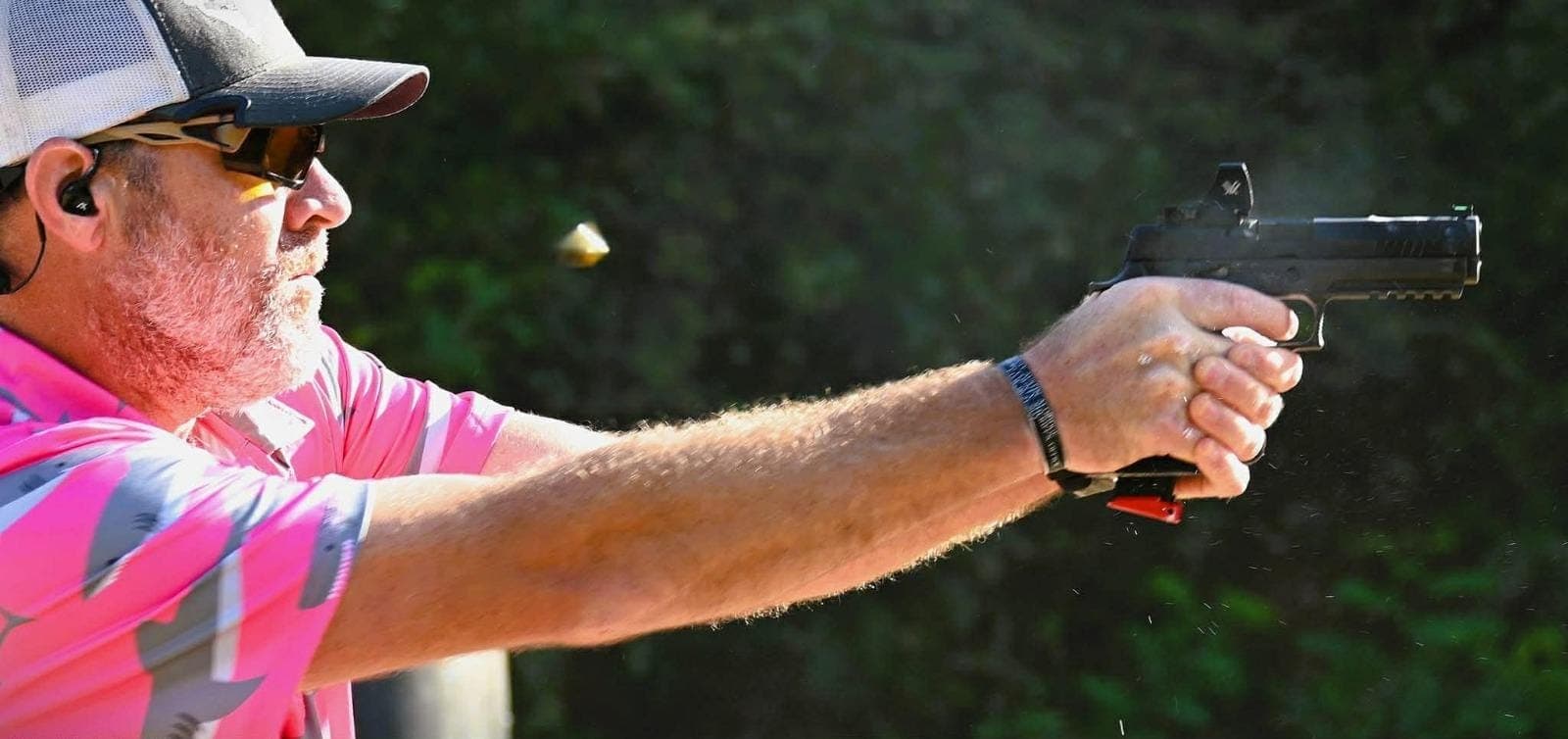
Here is something most instructors have seen: a student walks in with a $700 pistol, an optic that cost more than some people's first car, and a holster that came recommended on a forum. He's been carrying for two years. He has never once drawn from concealment under a timer. When you put him on the clock at seven yards, he fumbles the draw, breaks his grip midway through, and puts two rounds into the berm. The gun is not the problem. The gun is fine. The problem is that this student has confused acquisition with preparation, and nobody in his life has told him the difference.
That gap is exactly what Dojo Armed Defense was built to address. The organization, which I co-founded alongside retired SWAT operator John Hudson, operates on a premise that sounds simple until you try to build a curriculum around it: owning a firearm and being capable with a firearm are not the same thing, and treating them as equivalent does a real disservice to the people we are supposed to be serving.
My path to this work did not begin on a range. I came up through martial arts, and for a long time that was the lens through which I understood physical skill—the kind of competence that has to be earned through repetition, refined under pressure, and continuously tested against resistance. When I picked up a pistol in 2011, I recognized immediately that the same principles applied. The firearm is just a different discipline. The mechanics of skill acquisition do not change because the tool does.
What did change, at least in the world I was stepping into, was the culture around measurement. In martial arts, there is always a next level. There is always a way to know where you stand. In the civilian firearms community, I kept running into what I've come to think of as the talisman problem—the idea that the tool itself confers protection, that carrying means being prepared, that completing a qualification once is somehow the end of the conversation. It is not. It is barely the beginning.
"Training trumps talisman. The mental framework and problem-solving ability you carry are ultimately more decisive than the equipment you carry."
The curriculum at Dojo is structured around a belt progression, which I borrowed deliberately from martial arts for the same reason the martial arts community uses it: it creates a visible, measurable path and it honest about where a student actually is. The White Belt course is 200 rounds. It covers safety, nomenclature, assembly, marksmanship fundamentals, and how to practice. It is safety-focused and it does not rush past the basics, because the basics are not a formality—they are the entire foundation. Without them, nothing else holds.
The Yellow Belt course is 400 rounds and requires students to demonstrate a baseline before we move forward: from ten yards, ten shots at a six-inch circle, with eight of ten inside. That is not a high bar. But it is a real bar, and it forces an honest conversation about where the student's skills actually are versus where they imagine them to be. That conversation, uncomfortable as it sometimes is, is one of the most valuable things we do.
By the time a student reaches the Blue Belt course, we are working with 500 rounds, timed strings, draws from concealment, shooting while moving, working around cover, and what I call the 3 A's of personal defense—Awareness, Avoidance, and Application of Force. The sequencing is intentional. Awareness comes first because prevention is the most reliable defense. Avoidance comes second because most situations that can become violent do not have to. Application of Force comes last because it is the option of last resort—not the first tool you reach for, and certainly not the definition of preparedness.
WHAT COMPETITION TAUGHT ME
I hold a USPSA A Class classification in Limited Optics and I compete as often as my schedule allows. Some instructors treat competition as a separate hobby, something apart from defensive application. I don't see it that way. Competition is where my techniques go to be tested in a way that dry fire and controlled live fire sessions simply cannot replicate. There is a timer. There is a stage design you have never seen before. There is a score, public and objective, that tells you exactly how the technique held up under pressure and time.
What I have learned from competing is not which gear is fastest or which holster shaves a tenth of a second. What I have learned is how skills degrade under cognitive load, how grip problems that disappear at the ten-yard line reappear when you are moving laterally and making decisions simultaneously, and how the fundamentals—the ones we drill in White Belt—are still the fundamentals at A Class. They just have to be executed faster and more automatically. The process of chasing Master classification has made me a more demanding coach, because I know exactly what it takes to get from one level to the next and I can help a student see the same road.
My daily training routine blends dry fire, live fire, virtual reality training, and competition. Each serves a different purpose. Dry fire is where new movements are introduced and grooved. Live fire is where you get honest feedback on whether the groove is real or imagined. VR training introduces decision-making stress in a way that pure marksmanship work cannot. Competition is where everything is tested together, in public, under a clock. None of these replaces the others. The point is to develop a complete practitioner, not someone who is very good at one narrow version of the skill.
THE THING NOBODY TALKS ABOUT
I carry a lot. Not just a firearm. My daily carry includes a Wilderness Ankle IFAK with a North American Rescue CAT-7 tourniquet, chest seals, trauma gauze, and Quik-Clot. I carry a Fenix PD36R light, a POM pepper spray, a Leatherman Bolster, and a CRKT knife. I have been a Wilderness First Responder for over a decade, and that credential has informed something I say to students that sometimes surprises them: good medical training and proper trauma tools have a statistically higher chance of saving your life than your firearm does.
This is not an anti-gun statement. It is a math statement. The scenarios in which you will need a tourniquet—car accidents, industrial injuries, a range emergency—are far more common than the scenarios in which you will need to deploy lethal force. The firearm is last on my carry list for a reason. It is last because it is the tool of last resort, and treating it as the centerpiece of personal preparedness is a category error. The centerpiece is your judgment. The supporting architecture is your training, your medical capability, your awareness, and your willingness to avoid situations that do not need to become lethal encounters.
My Sig Sauer P365 X Macro with a Holosun EPS Carry in an Tenicor holster is a considered choice—slim enough to conceal comfortably, 17+1 capacity, enclosed emitter on the optic for reliability in field conditions. But it is one element in a larger system, and the larger system is what I am trying to teach students to think about. The gun is the last line, not the first.
"Most of the students who walk in thinking they are prepared are actually just armed. Those are different things."
The most common misconception I work against is this: that ownership equals security. It does not. A firearm you cannot run cleanly under stress, with a draw you have never practiced from concealment, in a situation you have never mentally rehearsed, is not a safety tool. It is an object. Objects do not make decisions. People do, and decisions made under stress default to whatever is most deeply practiced. If the answer to "what is most deeply practiced" is "nothing" then the gun provides very little protection and some additional risk.
This is what I mean when I say training trumps talisman. It is not a slogan. It is a description of how skill actually works. The mental framework you carry—your threat awareness, your willingness to avoid a problem before it escalates, your understanding of the legal and moral weight of using force—is more decisive in most scenarios than the caliber of your ammunition or the brand on your slide. Competence is earned. It is not purchased.
The students who make the most progress at Dojo are not necessarily the ones who come in with the most gear or the most prior experience. They are the ones who are honest about where they are, willing to be measured, and committed to the process of improvement after the class ends. That is the only thing I am actually trying to teach: how to learn, so that the learning does not stop when the range day is over.