
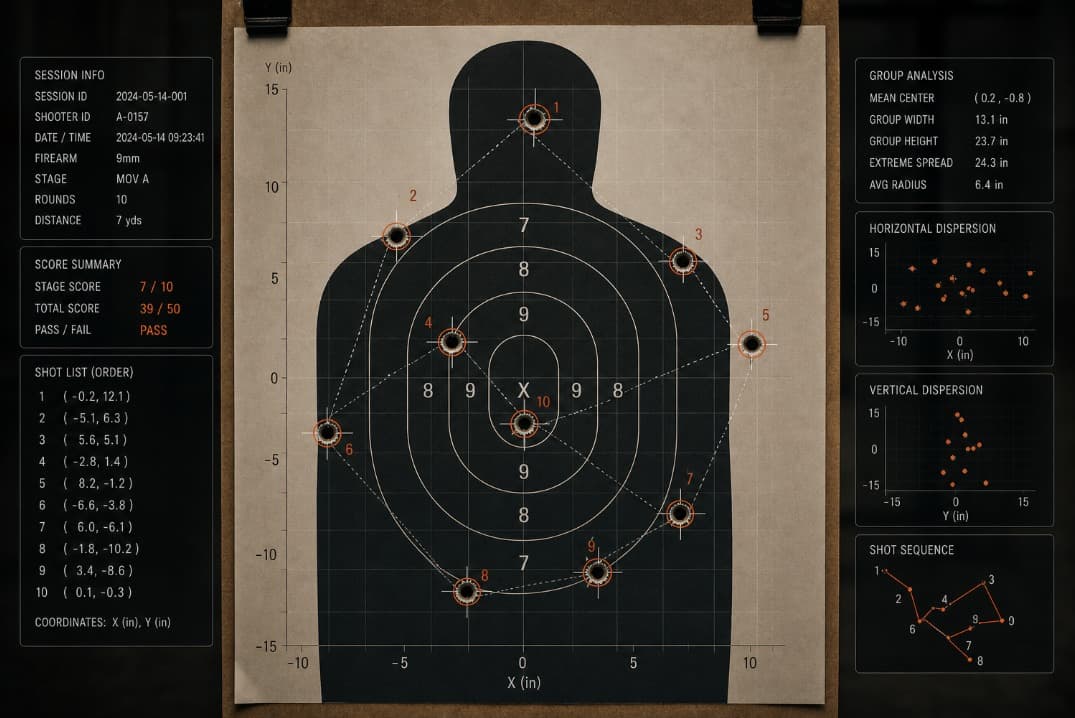
The argument in Parts I and II reduces to a single structural claim: a qualification record that contains only a score is not a qualification record. An administrative outcome. Part I showed what scores reveal when analyzed carefully: a persistent movement gap, wide organizational variance, a regression problem that was recorded but never triggered a response. Part II showed why the system cannot do better than that. Every finding in Part I is a finding about a number someone wrote. None of it is a finding about what happened on the target.
What would a record have to contain, at minimum, to be genuinely useful for training management? Not useful in the sense of better formatted. Useful in the sense of capable of answering the questions that Parts I and II proved the current system cannot.
The Evidence Layer: The Target Must Survive the Session
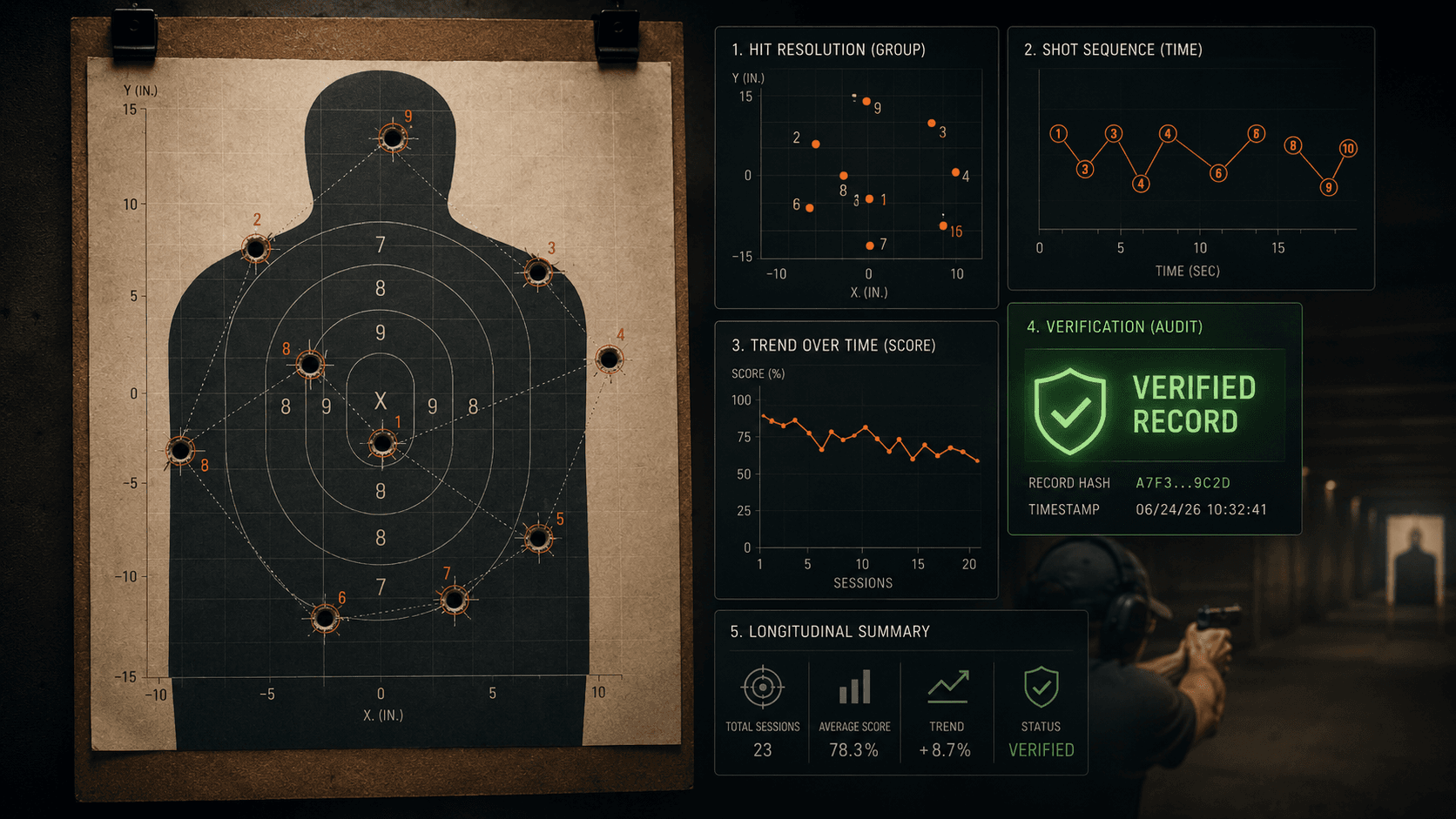
The most fundamental requirement of a valid qualification record is the one the current system fails completely: the target must survive the session in a reviewable form. Not the instructor’s notation of the target. The target itself, or a verified representation of it, linked unambiguously to the shooter, the session, and the stage in which it was produced.
This is the evidence layer. Without it, everything else is inference. A score of 7 on a movement stage is an instructor’s inference about what the target showed. It may be accurate. It may not be. No way to know, because the evidence is gone. A system that retains the target converts that inference into a fact. The score is no longer an opinion about what happened. A computation derived from physical evidence that can be reviewed, challenged, and audited.
Every other requirement in this framework depends on this one. A record without an evidence layer is a record in name only.
The Resolution Layer: A Score Is Not Enough Detail
Assuming the evidence layer exists, the next question is what the system extracts from it. A single integer per stage is the minimum output. Also, for training management purposes, nearly useless on its own.
What the resolution layer must produce is hit-level data: where on the target each round landed, in coordinates precise enough to reveal group pattern. Horizontal dispersion under movement stress points to grip instability. Vertical dispersion points to trigger control breaking down under time pressure. These are different problems with different corrections. A score of 7 tells you neither. Hit coordinates tell you both. The resolution layer is what converts a qualification from a pass/fail gate into a diagnostic instrument.
A score tells you a shooter is losing points on movement. Hit-level data tells you why. These are not the same thing, and one of them is actionable.
The Sequence Layer: Order and Timing Are Not Optional
A course of fire is not a static event. It is a sequence. Rounds are fired in order, from positions that change, under time constraints that introduce stress. The sequence in which those decisions were made contains information the aggregate group pattern does not.
Which rounds landed early in the string and which landed late? Did accuracy degrade as the string progressed, suggesting fatigue, or improve, suggesting the shooter settled into the movement? Did the first shot from each new position land differently than subsequent shots, pointing to a transition problem rather than a sustained accuracy problem?
A valid record captures sequence. Not because this level of analysis is required for every shooter in every session, but because it is required for the cases where the score trend alone is insufficient. The shooter who dropped 18 points across three sessions in the Part I dataset is exactly that case. A sequence-aware record would have flagged the mechanism of that decline before the third session confirmed it.
The Audit Layer: A Record That Cannot Be Verified Is Not a Record
The pencil-whip problem in Part II is not primarily an integrity problem. An architecture problem. The current system has no audit layer because the evidence does not exist in a form that supports verification. You cannot audit a number against a target that was discarded.
A valid qualification record must be cryptographically linked at the moment of capture: the image or data artifact, the computed score, the shooter identity, the session timestamp, and the administering entity bound together in a way that any subsequent alteration is detectable. This is how evidentiary records work in every domain where documentation is expected to survive legal scrutiny. Qualification records are not exempt from that standard. They are increasingly subject to it.
A record that cannot be verified is not a record. It is an assertion. The current system produces assertions and calls them documentation.
The Longitudinal Layer: One Session Proves Nothing
The regression finding in Part I is not a finding about individual shooters. A finding about the absence of longitudinal infrastructure. The system recorded each qualification in isolation. No mechanism to read a shooter’s fifth appearance against their first, to flag a trajectory, to distinguish a bad day from a drift pattern.
A valid qualification record is not a collection of independent events. A continuous document. Each session appends to the record that preceded it. The system must be capable of reading it that way. Trend detection, drift flagging, improvement verification: none of these are possible without a record architecture that treats longitudinal continuity as a first-order requirement, not a reporting feature.
This is the layer that separates a qualification system from a qualification management system. The former administers events. The latter manages development. Most agencies today have a folder of annual pass/fail outcomes and no thread connecting them. A valid record architecture makes that thread the primary output.
The Standard, Stated Simply
A valid qualification record contains five things: an evidence layer that retains the target; a resolution layer that produces hit-level data; a sequence layer that preserves order and timing; an audit layer that cryptographically binds the record to the event at the moment of capture; and a longitudinal layer that connects every session in a shooter’s history into a single readable document.
This standard does not describe a future capability. It describes what the qualification event already produces: the target exists, the hits exist, the sequence exists, the timestamp exists. It specifies only that the system must capture what is already there. The information has never been missing. The infrastructure to retain it has been.
The qualification event already produces the record. The system decides whether it survives.
What Comes Next
Systems that meet this standard are beginning to appear in the qualification infrastructure space. They are early. The field will take time to converge on implementations that satisfy all five layers reliably across the range of environments where qualification happens. But the direction is set and the standard is definable. The organizations that understand what it requires before the first vendor tells them what it requires are the ones that will evaluate solutions accurately rather than be sold a partial answer.
Every qualification session running today on a manual-entry system is producing a target that will come down at the end of the string, taking its information with it. How many more sessions that continues is a decision the training enterprise makes collectively, by what it demands, what it funds, and what it decides to call a record.